Why Believable AI Starts with Believable Data

AI analytics is quickly becoming the new frontier of decision intelligence. Boards, CEOs, CFOs, and operational leaders are no longer satisfied with siloed PowerBI dashboards, delayed reporting cycles, and narrow views of business performance. They want internal business intelligence that converses with the outside world. They want to ask questions in natural language. They want AI to combine operational data, historical context, external signals, and business meaning into answers they can act on.
But there are significant problems.
AI is only as believable as the data behind it. AI asking questions of the data can be unreliable.
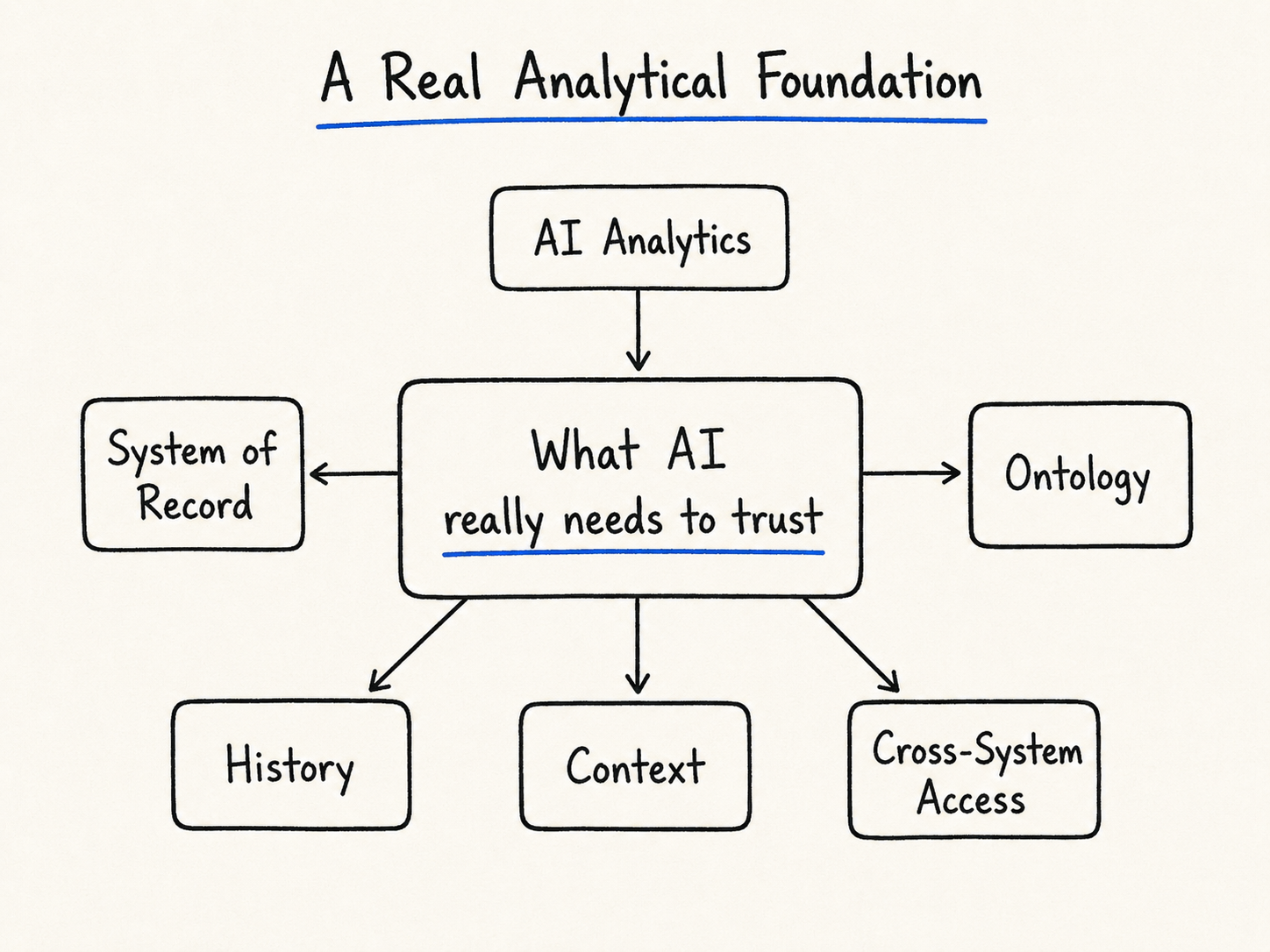
That is where the Data Vault architecture, as defined by Dan Linstedt, delivers significant value. His battle-tested approach is the most comprehensive architectural foundation for trusted, historised, cross-system, explainable business data. A data warehouse, built to the Data Vault standard, makes the data believable. Increased query reliability is also realised through the ontology baked into the data vault standard.
When Dan's Data Vault is combined with an AI-driven Engine and a Visual Studio, it changes the economics, speed, accuracy and accessibility of enterprise data warehousing.
This is the central idea behind AI-driven Data Vaulting: believable AI is a reliable aggregation of believable data.
Believable AI Requires Believable Data
For years, business intelligence has depended on the idea of a trusted system of record. Bill Inmon, widely recognised as the father of data warehousing, has long argued for the importance of believable data as the foundation of business intelligence.
That system of record must provide more than storage. It needs to behave like a true foundation for trust.
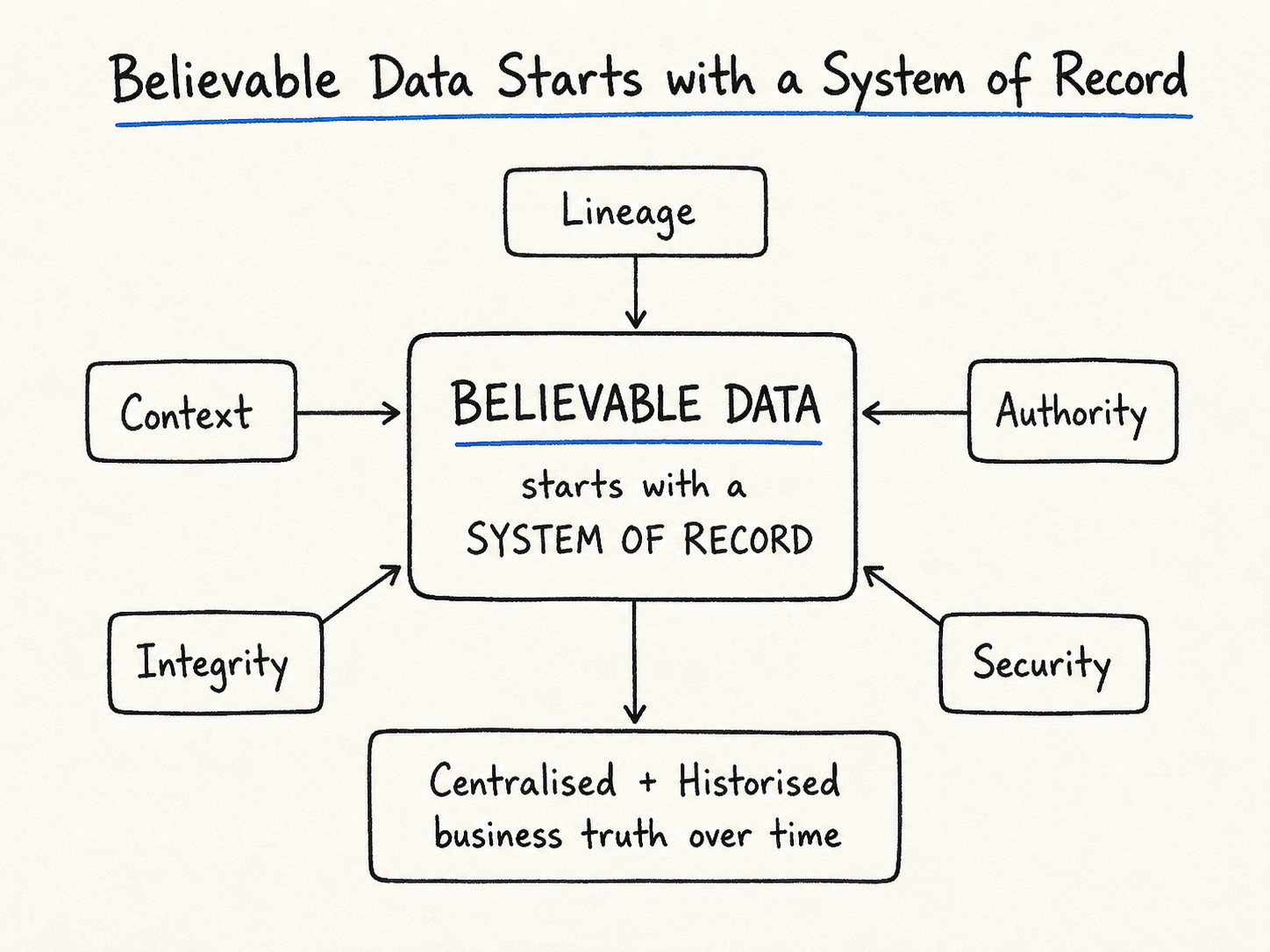
These qualities are mandatory when AI enters the enterprise. If an AI assistant gives a recommendation, generates an insight, or explains a performance trend, the business (or the Regulator) will eventually ask: where did that answer come from?
Without lineage, AI becomes astrology for the modern age.
Without history, AI becomes a random snapshot of noise.
Without context, AI becomes fools gold for gullible data miners.
Without authority, AI becomes just another source of doubt.
Believable AI needs a credible data foundation.
The Pre-AI Data Vault: Strong, But Hard Work
Data Vault has always had a compelling architectural story. It handles history well. It links data across systems through business keys. It tracks relationships over time. It separates structural business concepts from descriptive context. It gives organisations a scalable, auditable way to integrate many operational systems into a single warehouse.
The classic strengths of Data Vault are still relevant because they work together as a coherent architectural pattern.
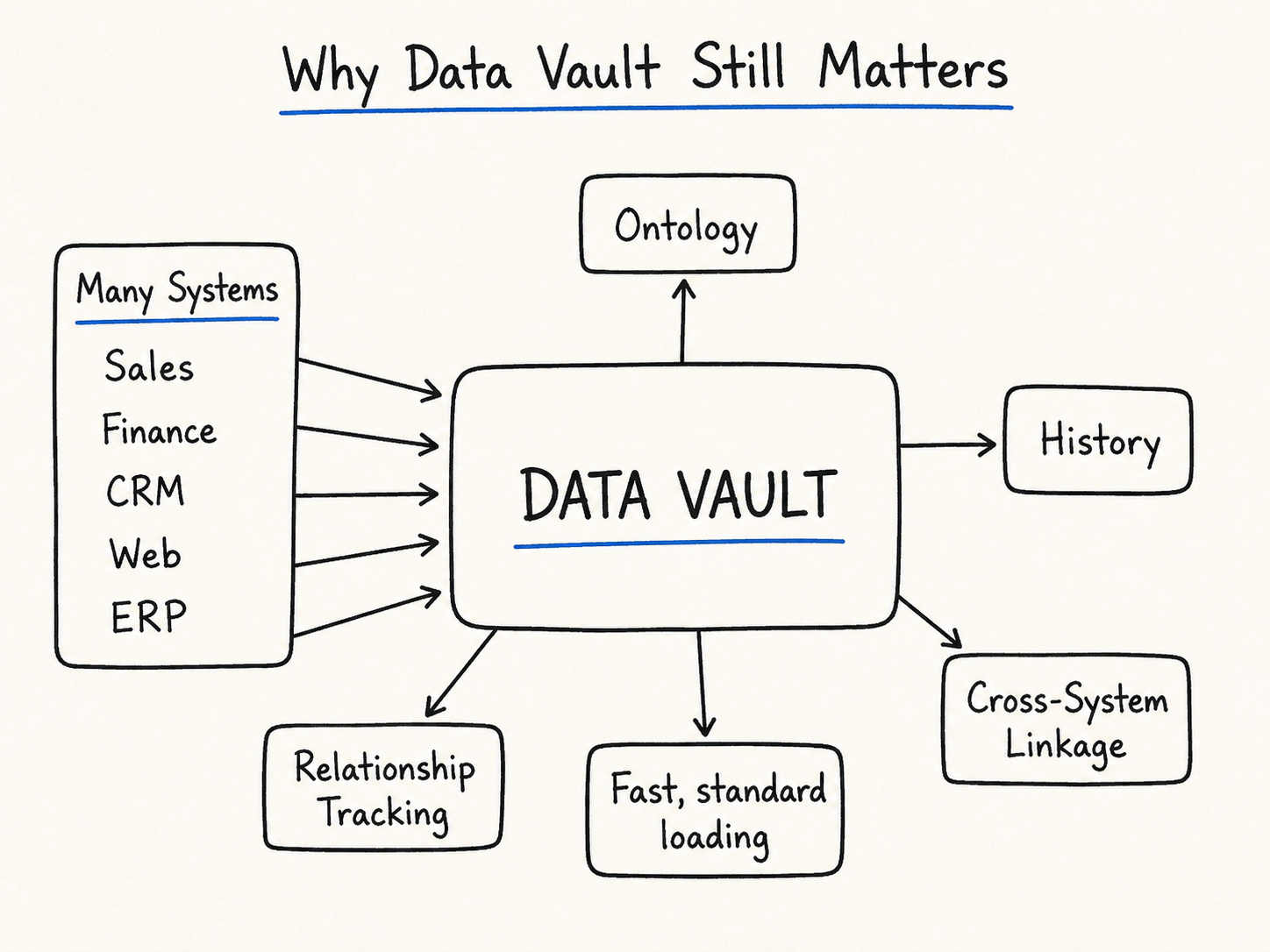
But the traditional Data Vault journey has also carried significant cost and complexity. Data Vault can be difficult to query directly. Automation has often been expensive. There is a lot of modelling, mapping, naming, documenting, loading, testing, and semantic-layer work. Skilled practitioners are scarce, delivery cycles can be long, and business-facing consumption layers are often built manually.
In other words, Data Vault has had the architecture AI needs, but not always the accessibility, speed, or economics that modern delivery demands.
Past problems are today's opportunities.
What AI Changes
AI changes Data Vault delivery in three major ways.
First, it reduces the cost of automation. Tasks that once required repetitive engineering effort can increasingly be accelerated through metadata, generation, validation, and prompt-assisted workflows. For example, we pointed our Data Vault Engine at Hubspot CRM and generated a data warehouse in a day plus all the cohort analysis using AI over the data vault.
Second, it improves profiling and discovery. AI can help explore source data, identify patterns, infer relationships, detect anomalies, and accelerate the early analysis that often slows warehouse programmes. The devil is alway in the data and early profiling is the key to any successful data warehouse project. With AI driven Data Vaulting you get profiling baked in.
Third, it magnifies scarce skills. AI will not magically turn an inexperienced user into a Data Vault expert, but it can help experienced engineers and architects move faster, explain decisions better, and reduce the burden of repetitive implementation work and documentation.
This is where the Millersoft AI Data Vault Engine & AI Data Vault Studio breaks new ground.
The Engine provides the open, scalable automation foundation. The Studio provides the workflow-driven interaction layer. AI does the grunt. Together, they shift Data Vault from a specialist craft activity into a more guided, metadata-driven operating model.
The AI Data Vault Engine
The AI Data Vault Engine is the automation operating system: the place where metadata, rules, connections, processing logic, documentation, change data capture, and vault refresh patterns come together.
The AI Data Vault Engine handles repeatable, explainable and scalable Data Vault delivery. It's written using the amazing Apache Hop project, making it fully customisable.
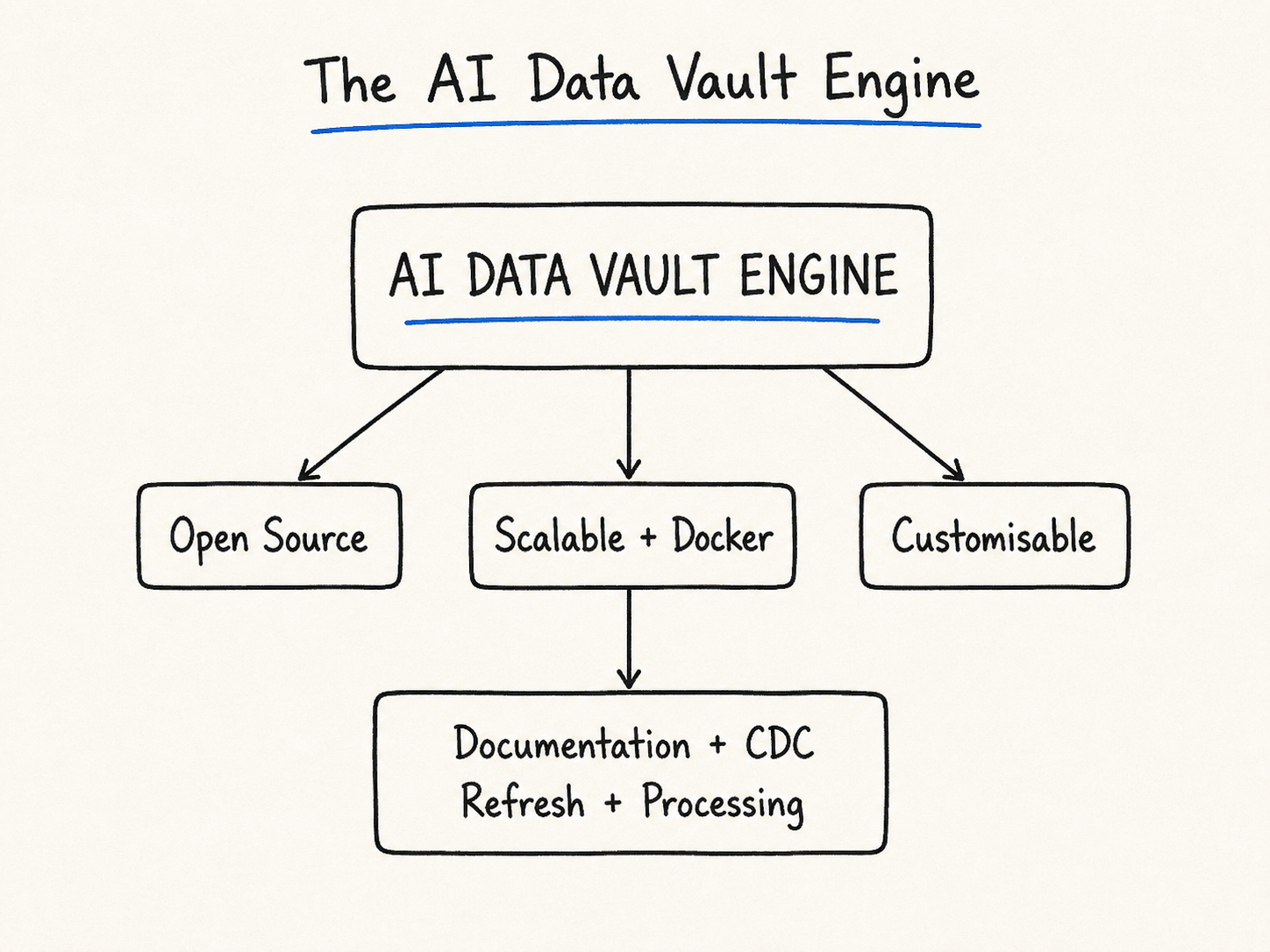
This matters because the future of data warehousing is open, accessible, extensible, and automated through metadata.
An open source Engine gives teams a foundation they can understand, extend, and adapt. Docker integration makes deployment and experimentation easier. Documentation generation helps keep the model explainable. Change data capture and refresh capability supports the continuous movement of business data into a historised analytical foundation.
Millersoft's goal is to create an open standard operating engine for believable business data.
That's why we have open sourced every last line of code on GitHub, to reinvigorate the data-warehouse market. AI hasn't pinched data engineering jobs, it has made experienced practitioners more relevant and more productive.
The AI Data Vault Studio
If the Engine is the automation core, the Studio is the human interaction layer.
A visual Studio is essential because Data Vault projects involve many knowledge domains: source systems, business keys, relationships, descriptive context, history, semantics, lineage, quality rules, and delivery workflows. Much of this knowledge is difficult to manage through code alone.
The Studio rocks because it turns Data Vault delivery from a code-heavy specialist exercise into a guided workflow environment.
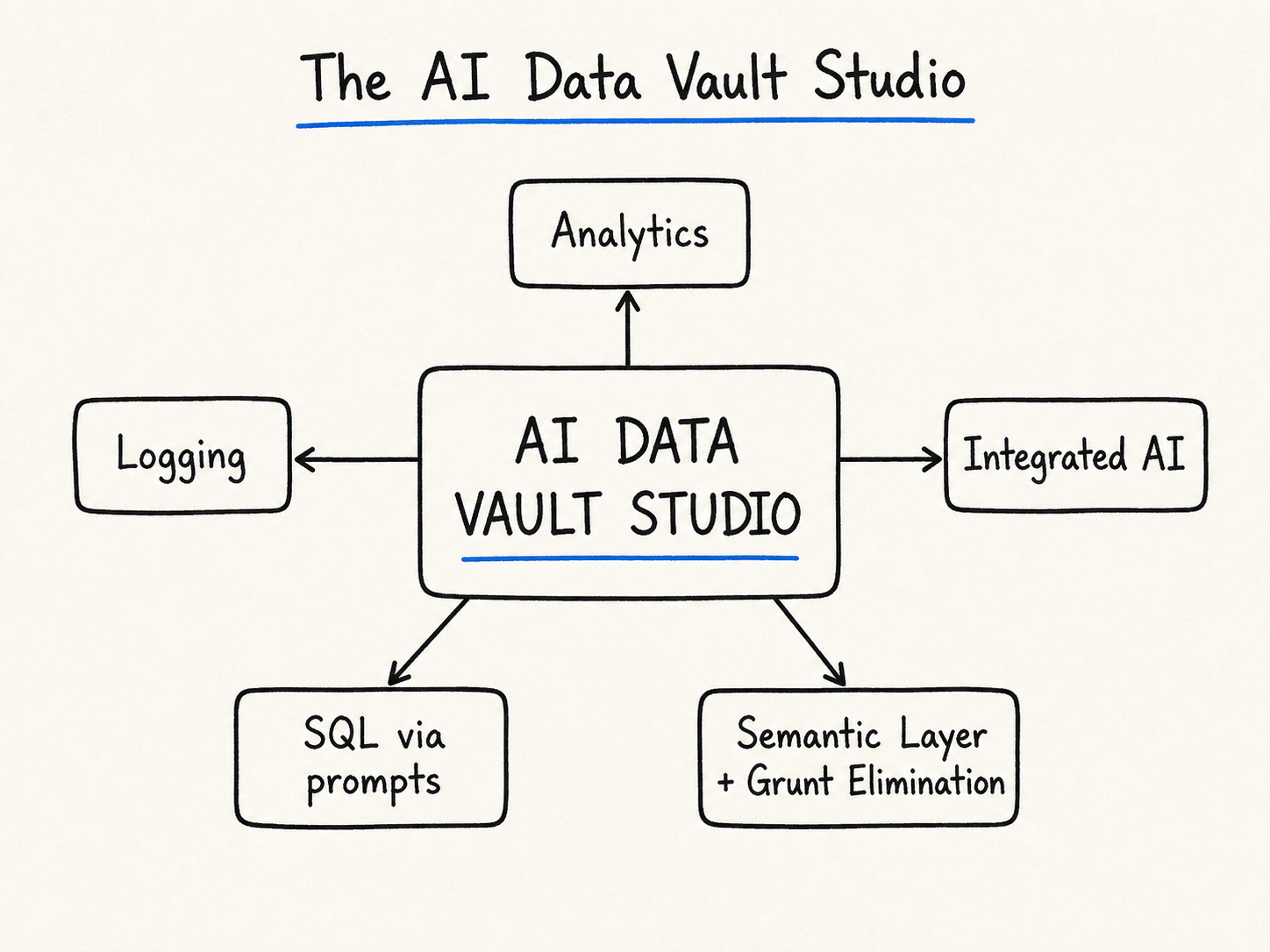
This is a significant shift. Traditionally, the semantic and business layer has often been manual, expensive, and separate from the warehouse modelling process. With AI-assisted generation and Studio-based interaction, the semantic layer can become a natural extension of the Data Vault metadata itself.
The ability to get AI suggested analysis and reports is possible now. With an accuracy much higher than any other AI technique because all the database queries leverage the context embedded in the Data Vault ontology.
That matters because AI does not just need data. It needs meaning.
A Studio that helps generate, validate, and expose business semantics can bridge the gap between raw historised data and business-facing AI analytics.
Why the Timing Matters
Several business forces are converging.
Executives want AI-supported business insight. Traditional dashboards and reports are no longer enough for many decision intelligence scenarios. Front-line staff increasingly expect to interact with systems through natural language prompts. Data from business systems is becoming accessible in new ways. Vendors are moving quickly. The old world of siloed datasets and narrow API-based reporting is reaching its limits.
At the same time, many organisations have discovered that a data lakehouse alone does not automatically solve the business integration problem. A lakehouse can be a useful storage and processing architecture, but without ontology, cross-system business keys, historical relationships, and semantic consistency, it just becomes a swamp infested staging area.
Organisations are also fast discovering that the Microsoft Medallion data classification is poor substitute for a professional data architecture. The Microsoft Medallion classification alone is insufficient for governed AI analysis.
AI needs more than files, formats, tables, and APIs. It needs a real analytical foundation.
The New Data Frontier
AI analytics, powered by Dan's Data Vault architecture and open source engines, is the new data frontier.
The losers will be the organisations still juggling siloed PowerBI dashboards on unknown origin. The winners will be the organisations with the most believable data and reliable queries. They will know where their data came from, how it changed, what it means, how systems relate, and why an AI-generated answer can be trusted.
That is the real opportunity for AI-driven analytics with Data Vaults.
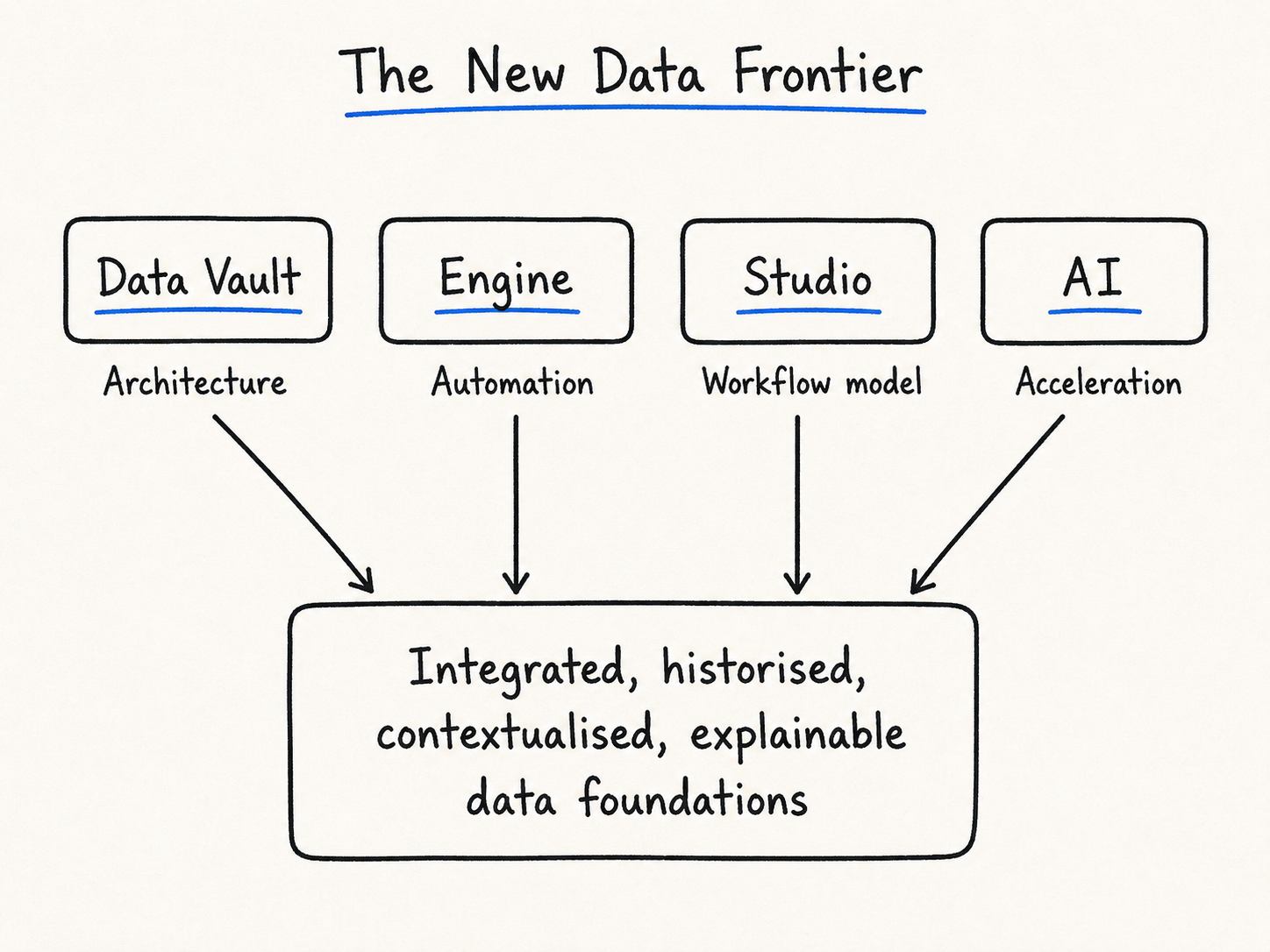
The Data Vault gives the architecture. The Engine gives the automation. The Studio gives the workflow and interaction model. AI gives the acceleration. Open source gives the data warehouse community a foundation to build on.
Analytics will be powered by integrated, historised, contextualised, explainable data foundations.
And for that, Data Vault is more relevant than ever.
More details here on the history of the Data Vault Engine and the Millersoft refinements.