Trusted property data. Better financial decisions.

A governed analytical foundation for property fund administrators, investment managers and financial reporting teams.
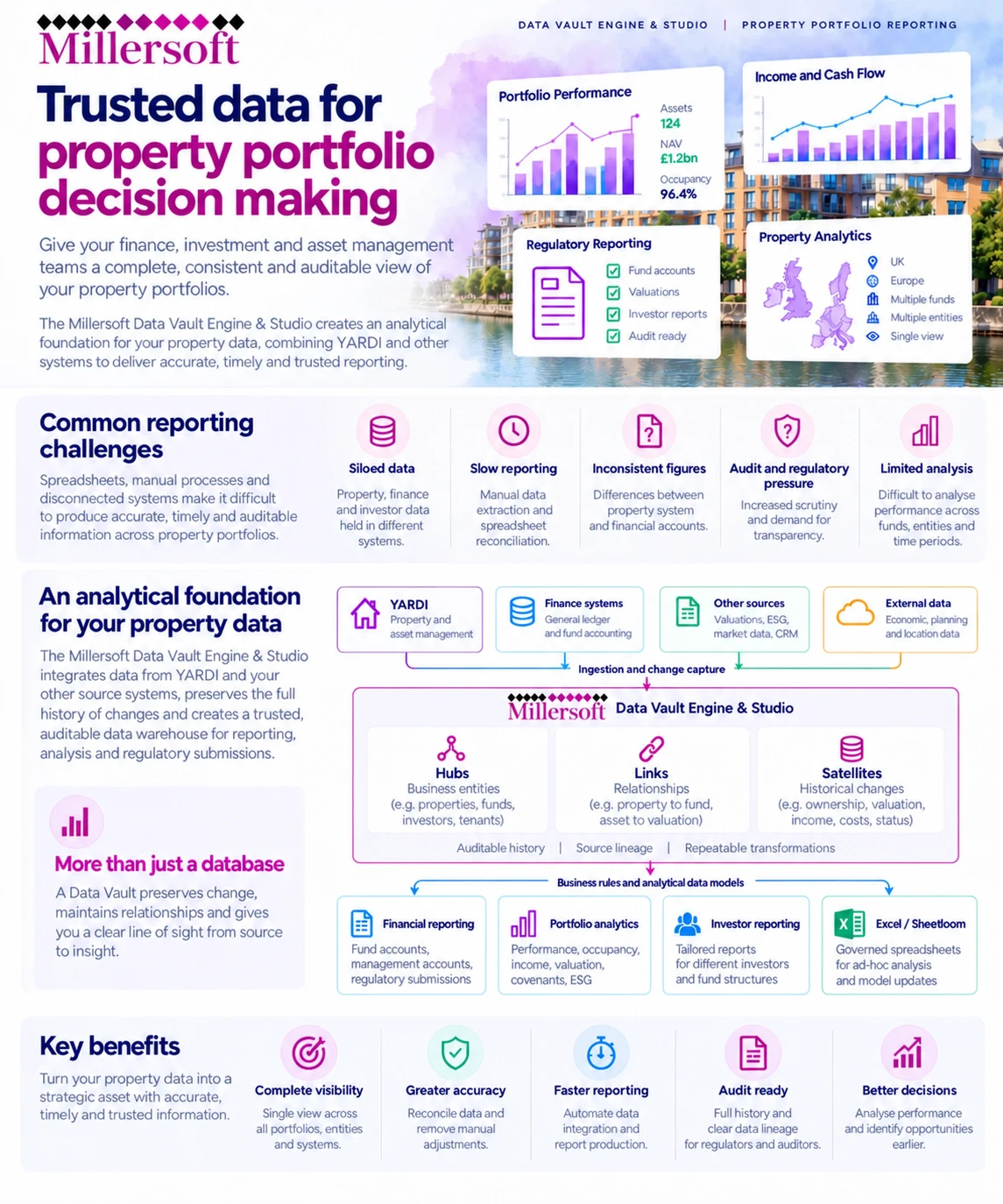
Property management platforms are essential operational systems. Yet fund accounts, investor statements and portfolio analysis often depend on data scattered across property ledgers, banking platforms, valuation files and manually maintained spreadsheets. Millersoft Data Vault Engine & Studio brings these sources together without replacing the systems teams rely on.
 (opens the full-size image in a new tab)
When reporting becomes a reconciliation exercise
Financial reporting teams need to explain not only what a portfolio is worth today, but how balances, valuations and ownership structures changed. Disconnected systems can make that explanation expensive, slow and difficult to reproduce.
The reporting pain points that matter
What makes the warehouse valuable
The value is not another dashboard. It is a dependable layer of integrated, historical data beneath fund accounts, investor reporting and investment analysis. Business rules remain explicit, source records remain traceable and downstream reports can use the same governed definitions.
From fragmented systems to portfolio intelligence
 (opens the full-size image in a new tab)
How the Engine & Studio works
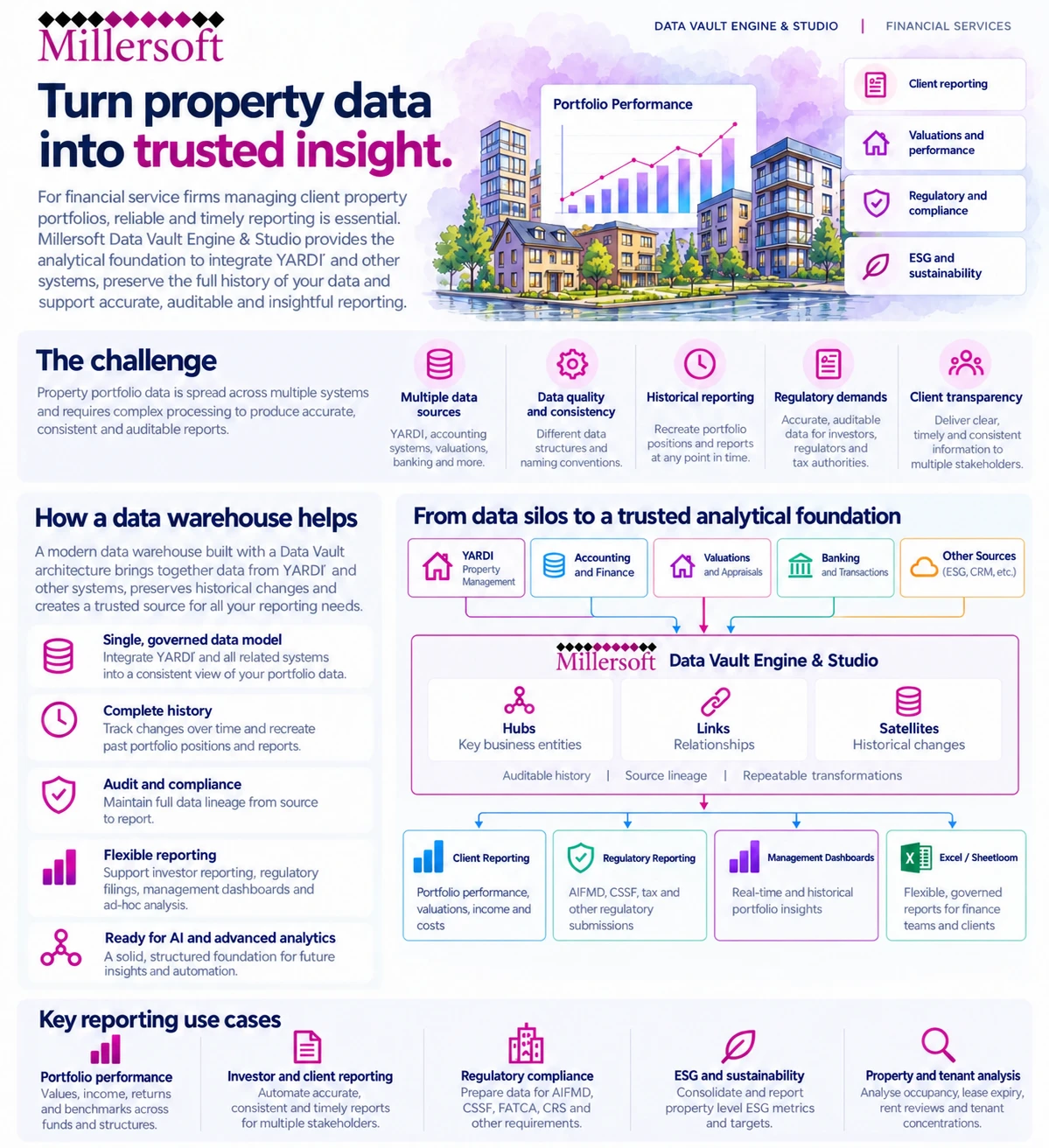
The Engine ingests permitted data from Yardi and complementary sources such as fund accounting systems, banks, valuation providers and document-derived datasets. Studio supports the design and maintenance of Data Vault models built around properties, leases, tenants, funds, legal entities and transactions.
Hubs preserve business identities, links preserve relationships and satellites retain descriptive changes with appropriate source and load timestamps. Curated business views then apply approved accounting, valuation and consolidation logic for reports and dashboards.
Integration method, extraction frequency and change capture depend on the customer’s licensed interfaces, deployment arrangements and available source history. A warehouse cannot recreate changes that were never captured.
A practical first engagement
Start with one high-value reporting problem
A strong initial demonstration is a quarter-end property-to-fund reconciliation. Select one fund, several properties and a reporting period. Compare property income and expenses with the fund ledger, identify timing differences and journal adjustments, then reconstruct the figures used in the original investor pack.
Illustrative delivery sequence
- Discovery: agree reporting definitions, source access, control requirements and the financial questions to answer.
- Pilot: ingest representative source data, model key business entities and demonstrate reconciliation with lineage.
- Expansion: extend to historical NAV, cash flow, investor reporting and multi-entity analytics after the pilot proves value.
The outcomes to measure
Measure time spent assembling monthly or quarterly packs, the number of unresolved reconciliation breaks, time required to answer an auditor’s query and the effort needed to reproduce a previously published figure. Establish a baseline before claiming improvement.
Designed to complement existing reporting tools
The warehouse can feed existing BI applications, controlled Excel models and Sheetloom-produced reporting packs. Finance teams keep familiar outputs while benefiting from a more consistent analytical foundation.
Make every number explainable
Talk to Millersoft about building a trusted analytical foundation for your property portfolios. Start with the reporting issue consuming the most time and prove the value with your own data.
Discuss your property reporting challengeYardi is a trademark of Yardi Systems, Inc. Millersoft is not affiliated with Yardi Systems, Inc.