Go beyond standard NetSuite™ reporting with an independent data warehouse

NetSuite™ can be central to running your business without becoming the permanent boundary of your business intelligence. As reporting spans more systems and more years of history, your organisation needs a dependable analytical record that it can retain and reuse independently of its ERP subscription.
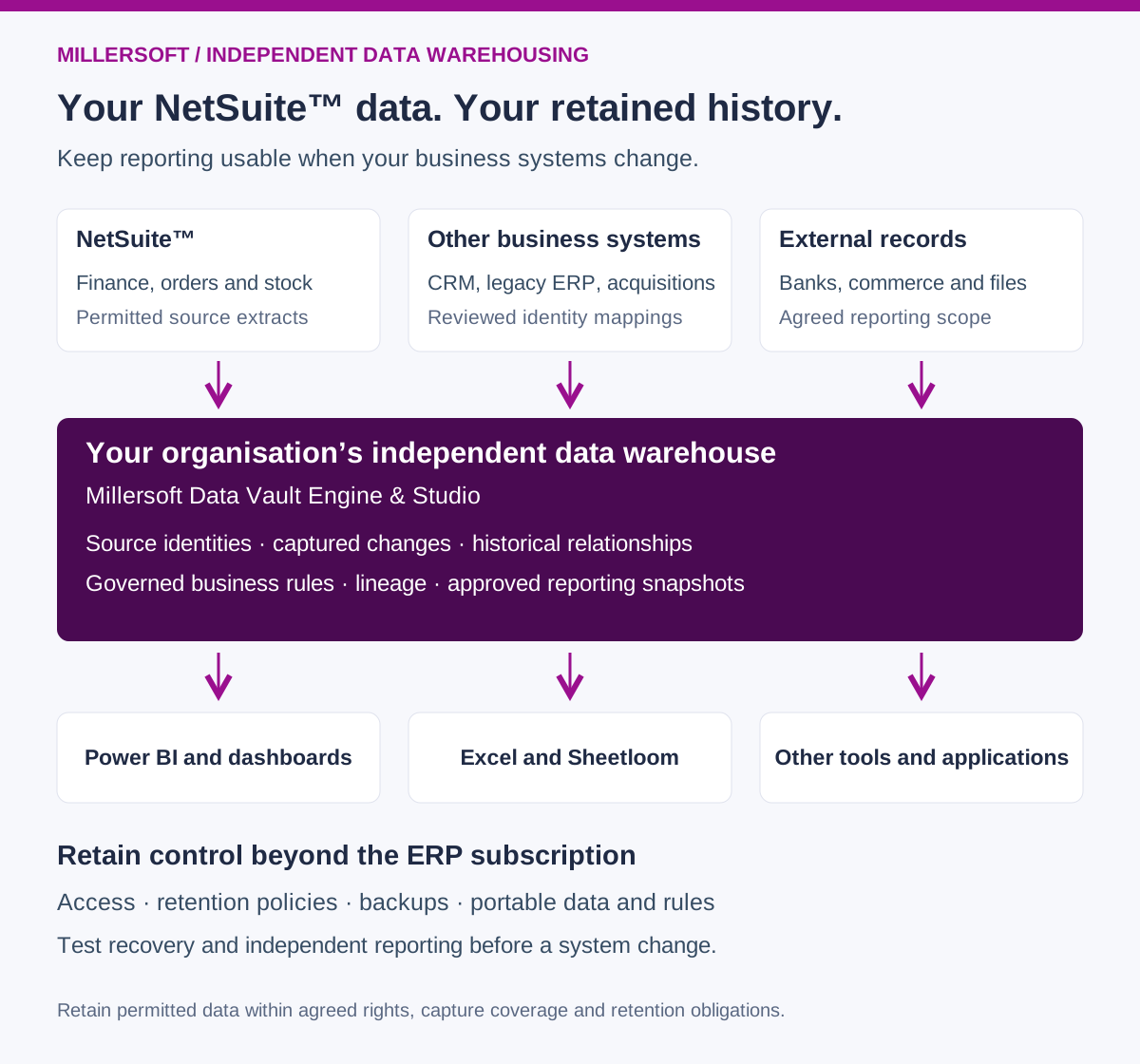
The open source Millersoft Data Vault Engine & Studio connects NetSuite™ with other business sources, preserves captured history and provides a governed foundation for reporting. The software is free and open source; source-access licences, infrastructure, implementation and support are separate considerations.
Keep your business history useful for as long as your organisation needs it, including when your ERP strategy changes.
 (opens the full-size image in a new tab)
Your reporting needs extend beyond your ERP
You can see the current position in NetSuite™. Can you reproduce the order book approved last quarter, explain stock-to-ledger differences, or measure customer contribution after returns and delivery costs? Can an acquired business still be analysed alongside the rest of the group when it runs a different ERP?
These questions need connected records, retained history and traceable definitions. An independent warehouse gives those analytical assets a home that your organisation can control, while NetSuite™ continues to handle day-to-day operations.
Five advanced NetSuite™ reporting challenges a Data Vault helps you solve
How Millersoft Data Vault Engine & Studio works
Data Vault Engine handles repeatable ingestion and historical modelling. Data Vault Studio provides a workflow for designing and maintaining the architecture. Together, they help preserve the evidence needed to explain changes across business systems.
We assess permitted extraction routes for your NetSuite™ deployment, including SuiteAnalytics Connect and appropriate APIs or controlled exports. Oracle describes SuiteAnalytics Connect as a read-only service for archiving, analysis and reporting through supported drivers. Coverage, permissions, refresh frequency and licensing must be established for the chosen route. Read Oracle's SuiteAnalytics Connect documentation.
The model retains source identities, relationships and descriptive changes, with source and load timestamps where available. Governed views apply your approved business rules and serve Power BI, Excel, Sheetloom and other analytical applications.
We validate custom fields, transaction relationships, updates and deletions against the required reporting scope. A warehouse can preserve captured history; it cannot recreate changes that were never recorded or extracted.
The disadvantages of keeping your warehouse within the ERP vendor's environment
NetSuite™ offers its own packaged warehouse and analytics service, now called NetSuite™ Data Intelligence, formerly NetSuite™ Analytics Warehouse. Oracle documents the name change in its November 2026 release notes. See Oracle's announcement.
The service combines Oracle Autonomous Data Warehouse and Oracle Analytics Cloud, with prebuilt analytics and support for NetSuite™ and third-party data. Those capabilities can be attractive when your organisation wants a packaged Oracle-based service. See the NetSuite™ product overview.
For an organisation prioritising independence, the disadvantages to assess are the dependencies that accumulate around that choice.
Your reporting investment becomes tied to another vendor platform
Dashboards, semantic models, transformations and operational processes built around the vendor's analytics stack can require redevelopment when you change platforms. Exporting rows is only part of an exit: the definitions that turn those rows into trusted figures also need to remain understandable and reusable.
An independent warehouse can keep the core model and business rules in your organisation's repositories, with documented interfaces to the reporting tools you choose.
Service tiers can shape the reporting architecture
Oracle's published warehouse tiers distinguish storage, users, additional NetSuite™ connections and features such as frequent refresh. Growth in data volume, subsidiaries or reporting demand may therefore require a different service package. Review Oracle's tier structure.
An external design lets you assess storage, compute and reporting capacity against your own workload. It still has operating and integration costs, so compare total expenditure and delivery effort rather than assume open source means a cost-free service.
ERP and analytics changes become more closely coupled
If your ERP and analytical environment share a supplier, a future ERP migration can become a wider programme involving data pipelines, analytics assets and subscription arrangements. Teams need a clear plan for how historical reporting will continue through that change.
An independently operated analytical record can remain in place while a new ERP feed is introduced. The source system changes, but the organisation can retain its historical identities, mappings and reporting definitions.
Long-term retention needs an explicit exit plan
Assess how complete data, historical versions, mappings, calculations and supporting evidence can be exported and used after a service change. A final dashboard download does not provide the same analytical continuity as a retained dataset with its rules and lineage.
The comparison is about practical control: who operates the retained copy, who can restore it and whether reporting can continue without the former analytics service. Check those capabilities against the actual subscription and export arrangements.
The advantages of a warehouse outside the ERP vendor's environment
An independent warehouse can be hosted in an account or environment controlled by your organisation, using agreed storage formats and infrastructure. Independence concerns your control and ability to move, rather than the name of the cloud provider alone.
| Reporting priority | Advantage of an independently controlled design |
|---|---|
| Data ownership and retention | Retain permitted source copies, captured history and approved reporting snapshots under your own retention policy. |
| Supplier choice | Select or replace hosting, implementation support, query engines and BI tools around documented interfaces. |
| Cross-system analysis | Give CRM, ecommerce, banking, logistics and acquired-company systems a place in the same business model. |
| Business rule control | Keep mappings, reconciliation logic and metric definitions accessible, versioned and reviewable. |
| ERP migration | Connect a replacement source while retaining earlier history and comparability across the transition. |
| Portability | Maintain tested exports, model documentation and recovery procedures that another provider can use. |
Open source helps make the implementation inspectable and maintainable. We also plan for portability of the data, deployment and transformations, because those determine how easily the platform can be moved in practice.
Improve AI analytics with a shared business model and ontology
AI analytics becomes more dependable when an assistant can work with explicit business concepts, documented relationships and approved measures. A question about “customer profitability” needs a consistent definition of the customer, the relevant orders and costs, and the reporting period before an AI system can produce a useful answer.
A business ontology defines concepts and their relationships. Data Vault is a recognised modelling and architectural approach that can underpin an enterprise ontology, rather than a complete ontology simply by virtue of its table structure. Its business identities, relationships and historical context provide a foundation to which we add a business glossary, metric definitions and a governed semantic layer. The Data Vault Alliance likewise emphasises shared terminology, business meaning, lineage and semantic preparation as part of the discipline. See the Data Vault Alliance's foundational guidance.
How this helps AI answer better business questions
| Foundation | Benefit for AI-assisted analysis |
|---|---|
| Stable business identities | Reviewed customer and product mappings help an assistant connect records across NetSuite™, CRM and other systems without assuming their identifiers are interchangeable. |
| Explicit relationships | Documented links between orders, invoices, returns and costs help select appropriate joins and avoid double counting. |
| Retained historical context | Captured changes and reporting cut-offs support questions about what was known at the time. Predictive analysis can use point-in-time datasets designed to avoid including information that arrived after the prediction date. |
| Governed metric definitions | Approved definitions for revenue, margin and contribution reduce ambiguity when generating queries or explaining results. |
| Source lineage | Results can be accompanied by their source references, transformation versions and reporting assumptions so a reviewer can investigate the evidence. |
We expose curated, permission-controlled analytical views and documented measures to AI tools. The raw vault supplies retained evidence; the semantic layer supplies business-facing meaning. Model quality, identity resolution, query validation and access controls still determine whether the answer is reliable.
Example: explain a fall in customer contribution
An illustrative assistant answering “Why did this customer's contribution fall last quarter?” needs more than the latest invoice total. The model can connect NetSuite™ sales and credit notes with delivery charges and service costs from other systems, apply the approved contribution definition, and use the agreed historical customer mapping.
The resulting explanation can identify the contributing movements and cite the underlying records. A versioned reporting cut-off also distinguishes the quarter as originally reported from a later corrected view.
What to assess in NetSuite™ Analytics Warehouse
NetSuite™ Data Intelligence, formerly Analytics Warehouse, provides AI capabilities and semantic modelling. Oracle documents extensions for joins, logical models and subject areas, including validation of grain and relationship cardinality. See Oracle's semantic-model extension guidance.
Its prebuilt model may not implement your chosen Data Vault architecture or enterprise ontology. Assess whether the supported customisations can express the cross-system identities, historical relationships, governed rules and portability your AI use cases require. An independent warehouse gives you control over implementing and retaining that foundation, while allowing suitable AI and reporting tools to use it.
Retain the business meaning alongside the data: identity mappings, metric definitions, model metadata and historical evidence should remain usable when you change ERP, analytics supplier or AI provider. That turns data ownership into continuity of analytical understanding.
Make data ownership real through retention and recoverability
Your business history is a long-term asset. Design for continued access before you need to leave a system.
Contractual ownership, extraction rights and technical control are separate questions. An independent warehouse strengthens your operational control when the retained data, documentation, credentials and recovery arrangements are genuinely accessible to your organisation.
We design that control around five deliverables:
- A retained analytical record. Preserve the permitted source data, business keys, captured changes and reporting snapshots required for the agreed use cases.
- Rules that remain understandable. Keep transformation code, account mappings, definitions and lineage alongside the records they explain.
- Access under your authority. Agree ownership of hosting accounts, administrative access, encryption-key arrangements and service-provider handover procedures.
- Backups and portable exports. Test restoration and export of representative datasets and models, rather than rely on a promise that migration will be possible later.
- A working retention and exit plan. Define retention periods, access controls, deletion obligations and the final extraction and reconciliation process before an ERP contract ends.
Retained reporting can continue after the source subscription changes only for the information you have lawfully captured and can still operate. A historic copy does not provide future ERP updates, and an analytical warehouse may not include every attachment or operational workflow. We agree the required archive scope explicitly.
A practical starting point: preserve a reconciled period outside NetSuite™
Consider an illustrative business planning to change ERP in two years. Its first pilot can focus on one subsidiary and a closed accounting period: retain the ledger, orders, invoices, stock records and supporting mappings needed for an agreed reporting pack.
Reconcile those records to the approved NetSuite™ outputs, then reproduce the pack from the independent warehouse. Introduce a test correction and demonstrate both the original snapshot and the revised view.
Finally, restore the pilot in an isolated environment with its own data, rules and documentation, without querying the live ERP. This tests whether the retained reporting is genuinely usable. It also identifies missing evidence early, while source access is still available.
Built to complement NetSuite™, with reporting that can outlast it
Keep NetSuite™ at the centre of transaction processing where it serves the business well. Use the independent Data Vault for historical analysis, cross-system reporting and the analytical records your organisation wants to retain under its own control.
Finance leaders gain stronger reconciliation and audit evidence. Operations managers can explain margin and stock movements. Group management gains a consistent view across businesses, while technology leaders retain more choice over the future platform.
The goal is continuity: your ability to understand past decisions should survive a change of ERP, analytics tool or support provider.
Further reading
- Millersoft ERP and CRM data integration services
- Millersoft NetSuite™ reporting with Sheetloom
- Millersoft Data Vault Engine & Studio
- Oracle SuiteAnalytics Connect documentation
Keep control of your NetSuite™ reporting history
Talk to Millersoft about an independent analytical foundation for your NetSuite™ data. Start with one reporting problem, prove reconciliation and retention, and build a platform your organisation can keep using as its systems change.
Discuss your NetSuite™ data warehouseNetSuite™ is a trademark of Oracle and/or its affiliates. Millersoft is not affiliated with or endorsed by Oracle.