NetSuite™ multi-company reporting across subsidiaries and ERPs

NetSuite™ multi-company reporting needs a consistent view of subsidiaries, currencies and internal transactions. The challenge becomes wider when an acquisition runs a separate NetSuite™ account or another ERP with different codes and definitions.
An independent warehouse can retain the local records, map them to an approved group model and produce a traceable bridge from each entity's reporting to the consolidated view.
Why adding local reports together is insufficient
A sale from one group company to another is revenue locally but not external group revenue. Different currencies require an approved translation basis. The same account name can describe different treatments across systems.
Source identifiers also need context. A customer or transaction number from one ERP instance should not be treated as the same record in another instance merely because the number matches. Use source, account and subsidiary identities before creating reviewed group mappings.
NetSuite™ OneWorld already provides consolidation capabilities. A warehouse can complement that operational structure where reporting spans other sources, requires retained mapping history or needs an independently controlled analytical record.
Real-world example: AESG's multi-currency consolidation
Azdan's AESG case study describes seven subsidiaries operating in multiple currencies and an earlier need for manual currency and intercompany corrections. Its work restructured the NetSuite™ configuration, including subsidiary relationships and elimination rules, to improve group reporting. Read Azdan's AESG case study.
This is a partner-reported ERP configuration project. It illustrates the importance of entity relationships and translation rules; it is not a Millersoft warehouse implementation or evidence that AESG uses the approach below.
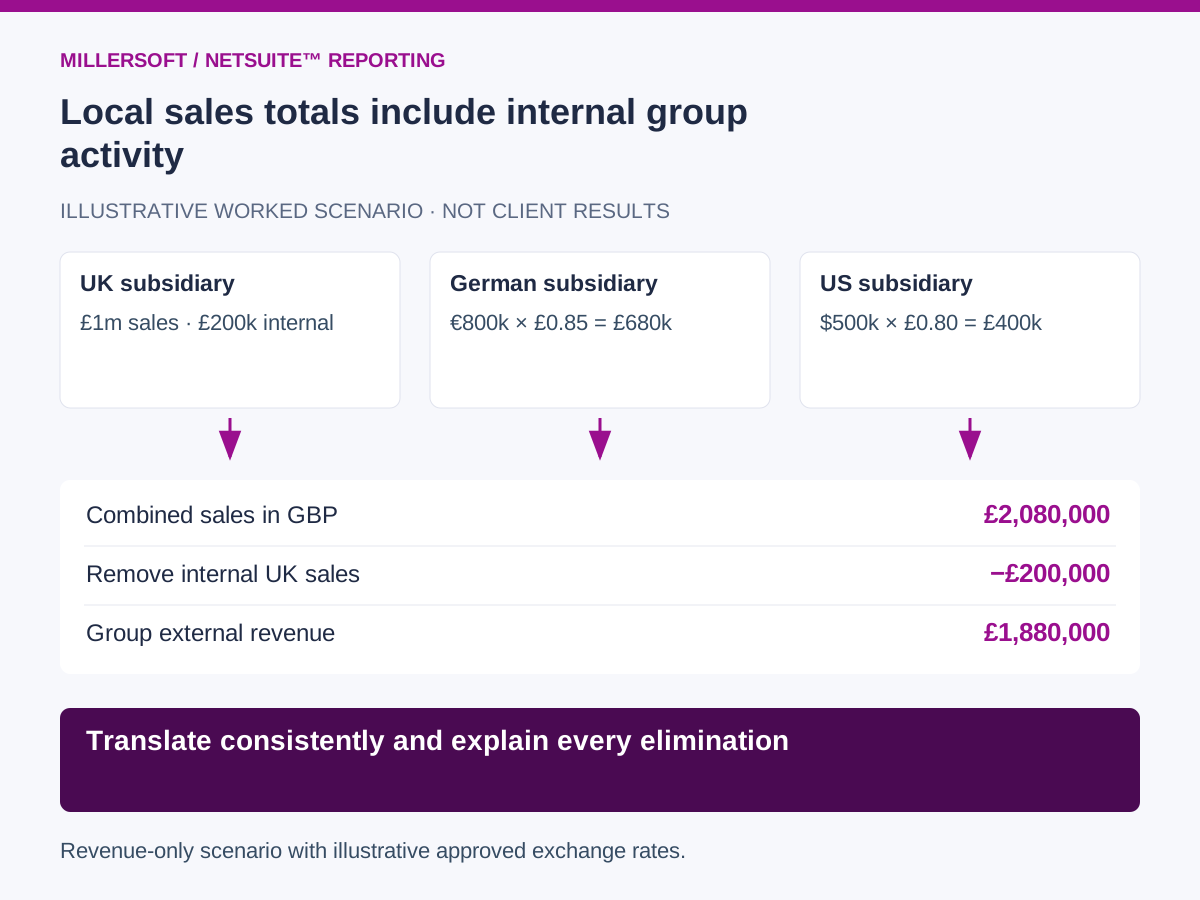
Worked scenario: £2.08 million of local sales becomes £1.88 million externally
Consider three illustrative wholly owned subsidiaries. The UK business reports £1 million of sales, including £200,000 to the German subsidiary. Germany has €800,000 of external sales, and the US entity has $500,000 of external sales.
Assume the approved period translation basis is £0.85 per euro and £0.80 per dollar, with no other revenue adjustments.
| Revenue bridge | Reporting currency amount | Basis |
|---|---|---|
| UK sales | £1,000,000 | Includes £200,000 internal sales |
| German external sales | £680,000 | €800,000 multiplied by 0.85 |
| US external sales | £400,000 | $500,000 multiplied by 0.80 |
| Combined sales before elimination | £2,080,000 | All entities in GBP |
| Remove UK intercompany sales | −£200,000 | Identified internal counterparty |
| Group external revenue | £1,880,000 | Sales outside the group |
The rates are illustrative assumptions. A complete consolidation also addresses reciprocal purchases and balances, ownership treatment, tax and any unrealised inventory profit. This example isolates the revenue bridge.
The warehouse should retain the source documents and rule behind the £200,000 elimination. A single unexplained deduction is difficult to distinguish from a manual reporting error.
 (opens the full-size image in a new tab)
Build the group model without discarding local meaning
Keep original account codes, currencies, documents and reporting periods. Map local accounts to group categories using effective-dated definitions with named owners and approval status. Retain both original and translated amounts.
Entity hierarchies need dates as well. Acquisitions and disposals change the reporting perimeter. Applying today's structure to an earlier year can change the comparison without any underlying transaction changing.
Customer and product mappings require review: a shared customer may have different local identifiers, while similarly named products may differ in pack size or specification. Keep unmatched records visible until their treatment is agreed.
Control translation and elimination separately
- Reconcile each entity's source totals before group adjustments.
- Check inclusion dates, reporting basis and the approved currency rate set.
- Identify intercompany counterparties and reciprocal transactions.
- Investigate timing, FX and missing-posting differences.
- Apply approved eliminations and retain the resulting bridge.
Start with two or three entities and one closed period. Measure unmapped accounts, unmatched internal balances and the effort needed to reproduce the group result.
Keep continuity through acquisitions and ERP changes
An independently controlled model can accept a replacement ERP feed while retaining earlier subsidiary records, mapping versions and reporting snapshots. That helps preserve comparisons across a migration, provided the source coverage and extraction rights are established before access changes.
Frequently asked questions
Can ownership percentages alone determine consolidation?
No. Finance must approve the applicable treatment based on control, arrangements and the reporting policy. Management and statutory views may have different purposes and should be labelled.
Do all entities have to use one NetSuite™ account?
No. A warehouse can combine permitted extracts from multiple accounts and other ERPs. It still needs consistent cut-offs, identifiers and reporting rules.
Continue exploring NetSuite™ reporting
Back to the independent NetSuite™ data warehouse overview.
- NetSuite™ forecast accuracy: compare sales predictions with bookings
- NetSuite™ profitability reporting: customer and product contribution
Make your NetSuite™ reporting explainable
Talk to Millersoft about a focused Data Vault Engine & Studio pilot using your permitted source data, reporting definitions and retention requirements.
Discuss your NetSuite™ reporting challengeNetSuite™ is a trademark of Oracle and/or its affiliates. Millersoft is not affiliated with or endorsed by Oracle.