NetSuite™ forecast accuracy: compare sales predictions with bookings

NetSuite™ forecast accuracy analysis compares a prediction made at a defined cut-off with the actual outcome for the same period and measure. A current pipeline report cannot, by itself, show how the forecast looked before deals slipped, changed value or were lost.
An independent warehouse can retain forecast submissions and opportunity history, then connect them to confirmed orders. This gives sales operations and finance a common basis for reviewing both the result and the reasons for the variance.
Define the prediction before calculating its error
NetSuite™ supports forecast categories, opportunity probabilities and salesperson overrides. Oracle documents that the values seen by a manager can differ from the automatically calculated forecast. A historical review therefore needs the submitted or approved version, including overrides. See Oracle's forecasting guide.
Agree whether the measure is unweighted committed bookings, weighted opportunity value, invoiced sales or recognised revenue. Those measures have different timing and meaning. Comparing a bookings prediction with an accounting revenue total can create an artificial forecasting problem.
Preserve the horizon too: a submission one week before month-end should not be compared as if it had the same uncertainty as a submission three months earlier.
Real-world example: Myers-Holum linked pipeline and resource planning
NetSuite™'s Myers-Holum story describes bringing sales pipeline, quoting and opportunity management together with project and resource information. The company used that connection to assess future resource availability before opportunities had closed. Read the Myers-Holum story.
That example shows why predictions have operational consequences: staffing decisions can depend on expected deals. The worked scenario below evaluates a frozen sales prediction; it does not attribute an accuracy score or warehouse implementation to Myers-Holum.
Worked scenario: £600,000 predicted, £420,000 booked
An illustrative team submits a manager-approved, unweighted forecast of September order bookings on 1 September. Values are before tax and in one reporting currency.
| Deal | Submitted September forecast | September bookings | Explanation |
|---|---|---|---|
| A | £250,000 | £225,000 | Won at a reduced value |
| B | £200,000 | £0 | Moved to October |
| C | £100,000 | £100,000 | Won as expected |
| D | £50,000 | £0 | Lost |
| E | £0 | £95,000 | Booked outside the original forecast |
| Total | £600,000 | £420,000 | Net shortfall of £180,000 |
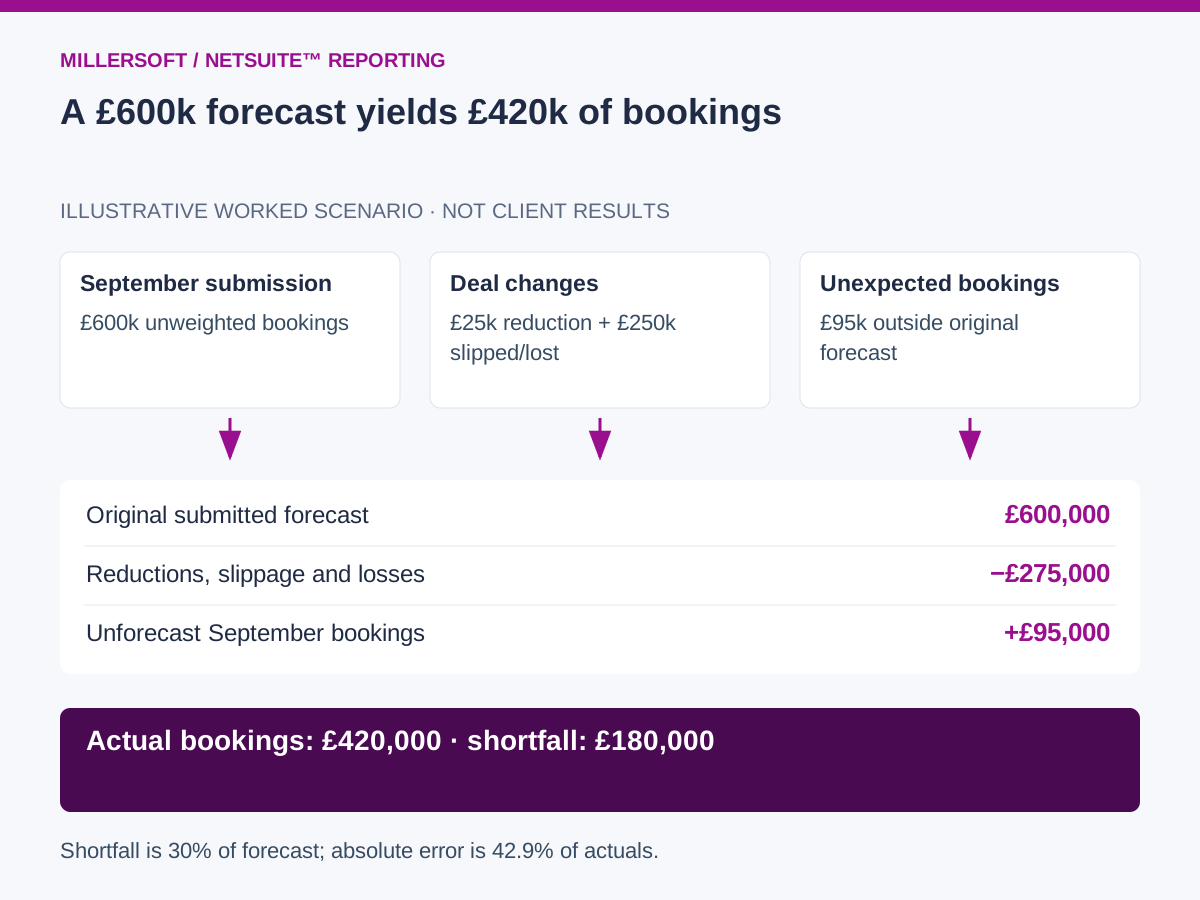
The bridge is £600,000 minus £25,000 of value reduction, £200,000 of slippage and £50,000 of losses, plus £95,000 of unforecast bookings. It ends at £420,000.
The shortfall is 30% of the submitted forecast. Absolute error divided by actual bookings is 42.9%. Label the formula and denominator rather than presenting either percentage as a universal “accuracy” score. When actual bookings are zero, the latter percentage is undefined; use an appropriate alternative such as absolute error.
 (opens the full-size image in a new tab)
Retain the original population and subsequent outcomes
Capture forecast issue date, reporting period, opportunity identity, account, subsidiary, salesperson, team, category, probability, value and expected close date. Keep overrides and manager approval separate from the current opportunity fields.
Retain opportunities that leave the original forecast population. Removing lost or slipped deals from the historical submission makes the prediction look better than it was. Identify newly created deals and those pulled forward from later periods separately.
Order relationships also matter. One opportunity may result in several orders, and later changes can affect the bookings definition. Reconcile the actuals to an agreed source report before attributing the movement.
Review forecast bias alongside total error
A surprise win can offset a major loss and produce a deceptively close total. Examine slippage, losses, value changes and unforecast bookings as well as the overall difference. Compare repeated submissions at consistent horizons to reveal patterns.
For probability-weighted forecasts, preserve the probability used at submission. Assess calibration across comparable opportunity groups rather than interpreting one lost deal as proof that its individual probability was wrong.
A first pilot can use one sales team and several completed months. Sales operations approves the forecast definition, finance confirms actual bookings, and both teams review the movement categories. Measure repeated overstatement or understatement and the completeness of captured submissions.
Retain forecast evidence for future analytics
Keeping submissions, mappings and outcomes independently makes the evaluation reusable after an ERP change. Historical training datasets can also use the information available at each prediction date, rather than accidentally include later deal outcomes as input features. This requires suitable capture and explicit point-in-time preparation.
Frequently asked questions
Does the current opportunity probability reproduce the old weighted forecast?
Only if it is the same probability that applied at the original cut-off. Retain earlier probabilities and submitted overrides when those are part of the forecast.
Does measuring error automatically improve forecasting?
No. It reveals patterns that teams can act on. Better close-date discipline, evidence-based categories and consistent review are operational changes, supported by the historical analysis.
Continue exploring NetSuite™ reporting
Back to the independent NetSuite™ data warehouse overview.
- NetSuite™ historical reporting: reconstruct past business positions
- NetSuite™ multi-company reporting across subsidiaries and ERPs
Make your NetSuite™ reporting explainable
Talk to Millersoft about a focused Data Vault Engine & Studio pilot using your permitted source data, reporting definitions and retention requirements.
Discuss your NetSuite™ reporting challengeNetSuite™ is a trademark of Oracle and/or its affiliates. Millersoft is not affiliated with or endorsed by Oracle.