Odoo™ profitability reporting: true margin by customer and product

Odoo™ profitability reporting becomes more useful when sales revenue is connected to the full cost of serving an order. A quoted margin can look attractive while returns, delivery, payment fees and after-sales work reduce the contribution actually earned.
A warehouse can bring Odoo™ orders and invoices together with stock costs, service time and external charges. The result is a defined, traceable contribution measure by customer, product or order.
Why sales margin can differ from customer contribution
An order may be discounted before invoicing and credited afterwards. Freight can arrive on a separate supplier bill. Support time may sit against a project or helpdesk ticket, and payment charges may appear only in a provider's settlement file.
These records need to be linked without counting the same cost twice. A landed freight charge already included in inventory cost should not also be deducted as a separate cost to serve. Returns also affect both revenue and the recoverable value of goods.
Define the measure before using the phrase “true profitability”. Gross margin, contribution after directly attributable costs and fully allocated operating profit answer different questions. Keep allocation assumptions visible and distinguish provisional estimates from final actual costs.
Real-world example: Single Source Supply's cost visibility
Odoo™'s Single Source Supply story describes the limits of basic profit-and-loss reporting and the use of connected operational modules to improve cost visibility. The company's adoption of Manufacturing provided more insight into the cost of goods. Read Odoo™'s Single Source Supply story.
That implementation illustrates why transactional cost detail matters. The contribution model below extends the analytical question to returns and cost to serve; its numbers are illustrative and do not describe that customer's results.
Worked scenario: £8,000 gross margin becomes £4,000 contribution
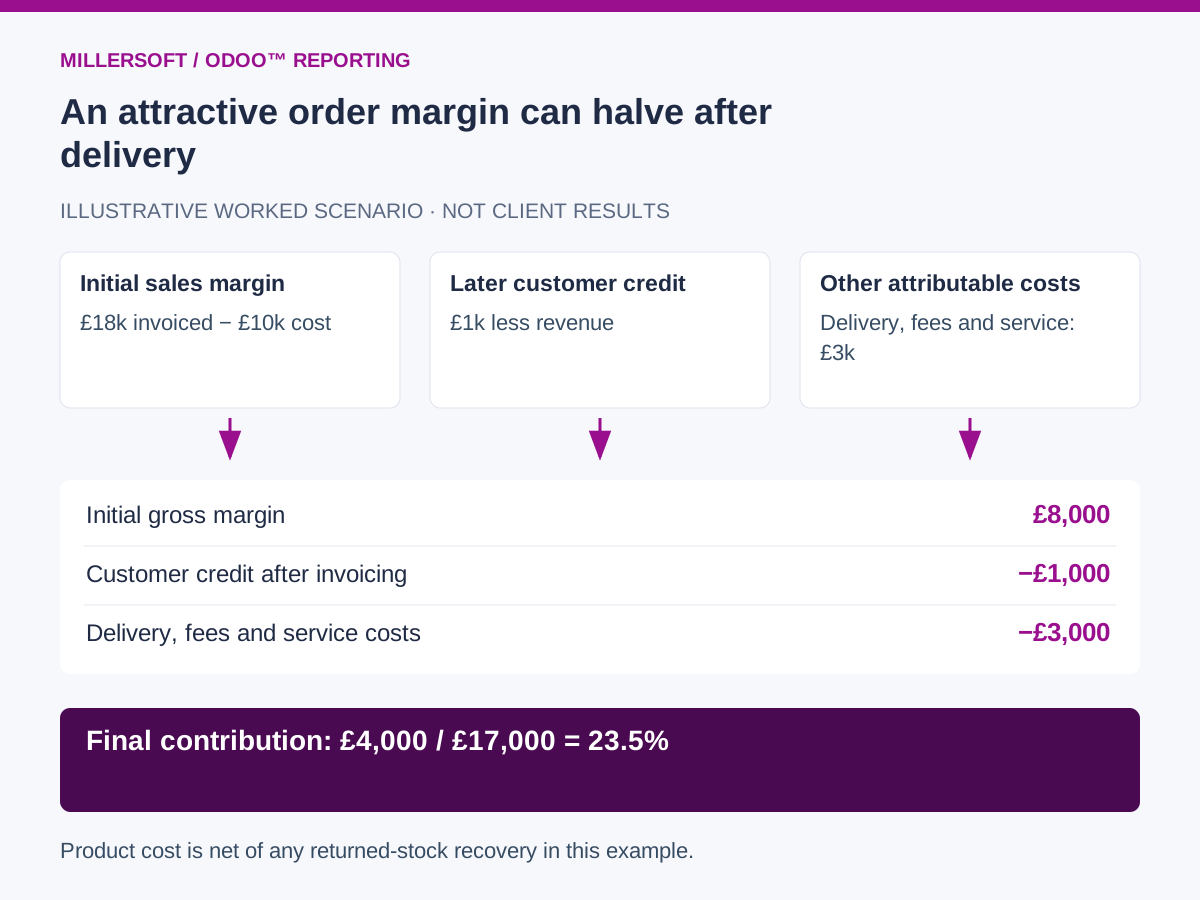
An illustrative order has a £20,000 list value and a £2,000 discount. Its £18,000 invoiced sales value, before a later credit, is compared with £10,000 of product cost in an initial margin view.
| Revenue or cost | Amount | Treatment in the final contribution view |
|---|---|---|
| Invoiced sales after discount | £18,000 | Revenue before later credit |
| Subsequent customer credit | −£1,000 | Reduces net revenue to £17,000 |
| Product cost | −£10,000 | Assumed net of any returned-stock recovery |
| Outbound delivery | −£1,200 | Attributable cost, not already capitalised |
| Payment fees | −£300 | Matched to the order's receipts |
| After-sales service | −£1,500 | Approved hours and cost rates |
| Contribution | £4,000 | Before unallocated overheads and tax |
The initial £8,000 margin was 44.4% of £18,000. The final £4,000 contribution is 23.5% of £17,000 net revenue. Both the amount and denominator changed, so label each percentage clearly.
This does not establish the customer's overall profit. Shared overheads, financing and other costs may remain outside this contribution measure.
 (opens the full-size image in a new tab)
Link revenue and cost at a defensible level
Retain order and invoice line identifiers, credit-note links, product identities, customer-group mappings and relevant currencies. Connect product costs using the applicable cost basis and preserve later adjustments.
External carrier invoices and payment settlement files need source references and a matching process. Where direct attribution is impossible, use an approved allocation driver such as parcel count, weight or order value. Keep unallocated costs visible rather than distributing them with an unexplained balancing rule.
For services, record time, task or ticket references, effective cost rates and approval status. Limit access to sensitive employee cost data while exposing appropriate aggregated contribution results.
Make provisional and final margins distinguishable
A recently shipped order may not yet have its carrier invoice or final service cost. Publish an estimated contribution when needed, with clear assumptions and a status flag. Retain the original estimate so later analysis can explain why the final result differs.
Start with one customer group and a completed order cohort. Reconcile net revenue to accounting, check cost completeness and have finance approve allocation rules. Measure unmatched costs, the proportion of estimated versus actual amounts and the time taken to answer a margin query.
A useful dataset supports decisions about pricing, service levels and fulfilment choices because the underlying evidence remains accessible.
Frequently asked questions
Can every cost be assigned accurately to an individual order?
No. Some costs are shared or lack a reliable link. Report allocation methods and unallocated balances so readers understand the limits of the measure.
Should margin always use the latest product master cost?
Use the approved basis for the question being answered. Historical realised margin generally needs the relevant transaction costs and subsequent adjustments, rather than an unexplained substitution of today's product cost.
Continue exploring Odoo™ reporting
Back to the Odoo™ data warehouse overview.
- Odoo™ multi-company reporting: consolidate across entities and systems
- Odoo™ stock valuation reconciliation: connect inventory and finance
Make your Odoo™ reporting explainable
Talk to Millersoft about a focused Data Vault Engine & Studio pilot using your Odoo™ data, reporting definitions and control requirements.
Discuss your Odoo™ reporting challengeOdoo™ is a trademark of Odoo™ S.A. Millersoft is not affiliated with Odoo™ S.A.