Odoo™ multi-company reporting: consolidate across entities and systems

Odoo™ multi-company reporting brings separate legal entities into a consistent management view. The challenge grows when an acquired business uses another Odoo™ instance or a legacy ERP, with different account codes, customer identifiers and currencies.
A warehouse can integrate those sources, retain their original records and apply approved group reporting definitions. It can support consolidation analysis while preserving the detail needed to explain each entity's contribution.
Why adding company reports together can overstate performance
One company may sell to another group company. Adding both sales totals includes an internal transaction in group revenue. Local currency amounts cannot be combined without a translation policy, and matching account names do not guarantee matching definitions.
Source identifiers also need context. Record 42 in one Odoo™ database may be entirely unrelated to record 42 in another. Use the source instance, company and record identity together before creating a group mapping.
Define whether the output is a management comparison or a formal consolidated reporting view. Consolidation scope, control assessments, translation rules and eliminations need approval from the responsible finance team.
Real-world example: Pavlov Media's connected companies
Open Source Integrators' Pavlov Media case study describes several operating companies, including separate legal entities, sharing transactions and services. Its Odoo™ implementation addressed intercompany sales and purchasing and the presentation of services from multiple companies on a customer statement. Read the Pavlov Media case study.
This partner-reported example shows the importance of clear entity and transaction relationships. The warehouse design below addresses cross-system analysis and historical reporting; it is not a description of Pavlov's reporting architecture.
Worked scenario: £1 million plus €600,000 is not group revenue
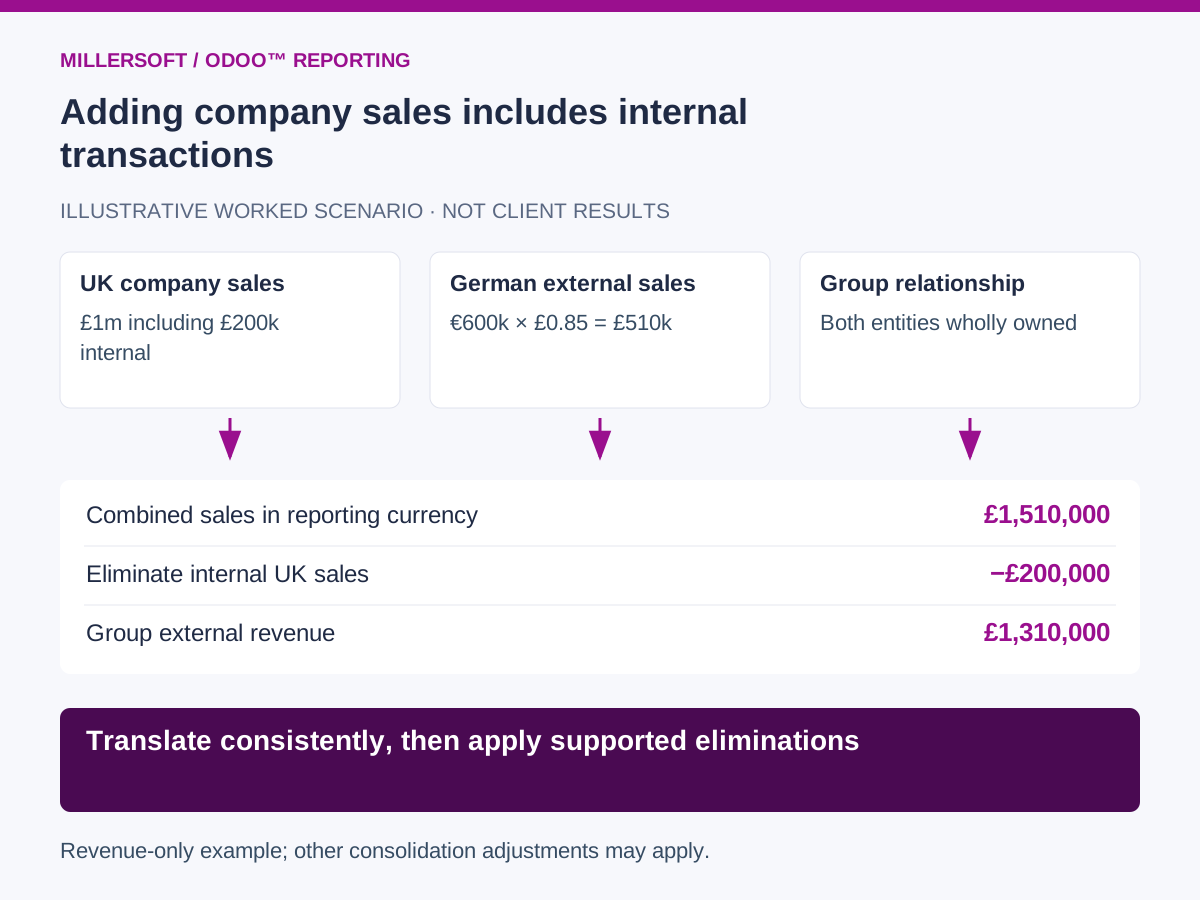
Consider two illustrative wholly owned companies. The UK business reports £1 million of sales, including £200,000 sold to the German business. Germany reports €600,000 of external sales. Assume the approved period translation basis is £0.85 per euro.
| Group revenue bridge | Amount | Explanation |
|---|---|---|
| UK reported sales | £1,000,000 | Includes intercompany sales |
| German external sales translated | £510,000 | €600,000 multiplied by 0.85 |
| Combined sales before eliminations | £1,510,000 | Both entities on one currency basis |
| Eliminate UK intercompany sales | −£200,000 | Internal revenue excluded from group sales |
| Group external revenue | £1,310,000 | Sales to customers outside the group |
This simplified example isolates revenue. A complete consolidation must also consider reciprocal purchases and balances, tax, ownership treatment and unrealised profit in stock where relevant. The single FX rate is an illustrative approved assumption, not a universal translation rule.
The warehouse should identify the counterparty and supporting documents for the £200,000 elimination. A manual deduction with no transaction trail makes the total harder to defend.
 (opens the full-size image in a new tab)
Build a common model without losing local meaning
Retain each entity's original account codes, amounts, currencies and document references. Map them to group reporting categories through effective-dated rules, with an owner and approval status. Preserve local views alongside the group model.
Customer and product mappings need similar care. Two subsidiaries may use different codes for the same external customer, while apparently identical products may differ in specification or pack size. Keep reviewed mappings and unmatched records visible.
Store entity hierarchies and reporting perimeters over time. An acquired company should enter the relevant group view at the approved date. Applying today's hierarchy to all earlier periods can distort comparisons.
Control currency and intercompany treatment
Maintain approved rate sets and specify which rates apply to each measure. Keep original-currency values so reviewers can distinguish operational movements from translation effects. Translate balance-sheet and income measures according to the applicable policy.
Match intercompany transactions using entity pairs and document relationships, with tolerances agreed by finance. Separate timing differences, FX differences and genuinely missing postings. Do not force elimination of an unresolved balance merely to produce a neat total.
For a pilot, choose two entities and one reporting period. Reconcile each local result first, then demonstrate the currency and elimination bridge. Measure unmapped accounts, unmatched counterparties and the effort required to explain group adjustments.
Frequently asked questions
Must every company move to the same Odoo™ database?
No. A warehouse can combine permitted extracts from separate instances and other ERPs. Consistent identifiers, mappings and extraction controls remain necessary.
Does a common chart of accounts remove the need for reconciliation?
It helps, but differences can still arise from timing, currency, scope and local accounting treatment. Source totals and group adjustments still need validation.
Continue exploring Odoo™ reporting
Back to the Odoo™ data warehouse overview.
- Odoo™ sales forecast accuracy: compare pipeline predictions with results
- Odoo™ profitability reporting: true margin by customer and product
Make your Odoo™ reporting explainable
Talk to Millersoft about a focused Data Vault Engine & Studio pilot using your Odoo™ data, reporting definitions and control requirements.
Discuss your Odoo™ reporting challengeOdoo™ is a trademark of Odoo™ S.A. Millersoft is not affiliated with Odoo™ S.A.