Yardi™ NAV reporting: preserve property valuation history

Property fund net asset value (NAV) reporting depends on more than the latest appraisal. Finance teams need the valuation, debt, cash, ownership and foreign exchange assumptions that applied at each reporting date, together with the versions approved for publication.
A warehouse alongside Yardi™ can retain those inputs and support a NAV movement bridge that distinguishes investment performance from capital activity and currency effects.
Why the latest valuation file cannot explain last quarter
A valuer may issue a revised appraisal after the initial submission. Asset managers update capital expenditure assumptions. Ownership percentages change, and a foreign currency valuation can move in reporting currency without any change in local market value.
If the reporting process overwrites previous files, a later rerun may silently change a published NAV. Store the valuation effective date, receipt date, approval status and version separately. The date a value relates to is different from the date the team first knew it.
Real-world example: valuation changes across property sectors
British Land's full-year results for the year ended 31 March 2025 reported different valuation movements for retail parks and campuses, alongside a separate EPRA Net Tangible Assets measure. These are distinct reporting measures with different inputs. See British Land's 2025 results.
This public reporting example shows why a portfolio-level value movement needs supporting analysis by asset and measure. It is not evidence that British Land uses the warehouse approach described here.
Worked scenario: bridge a £4 million NAV increase
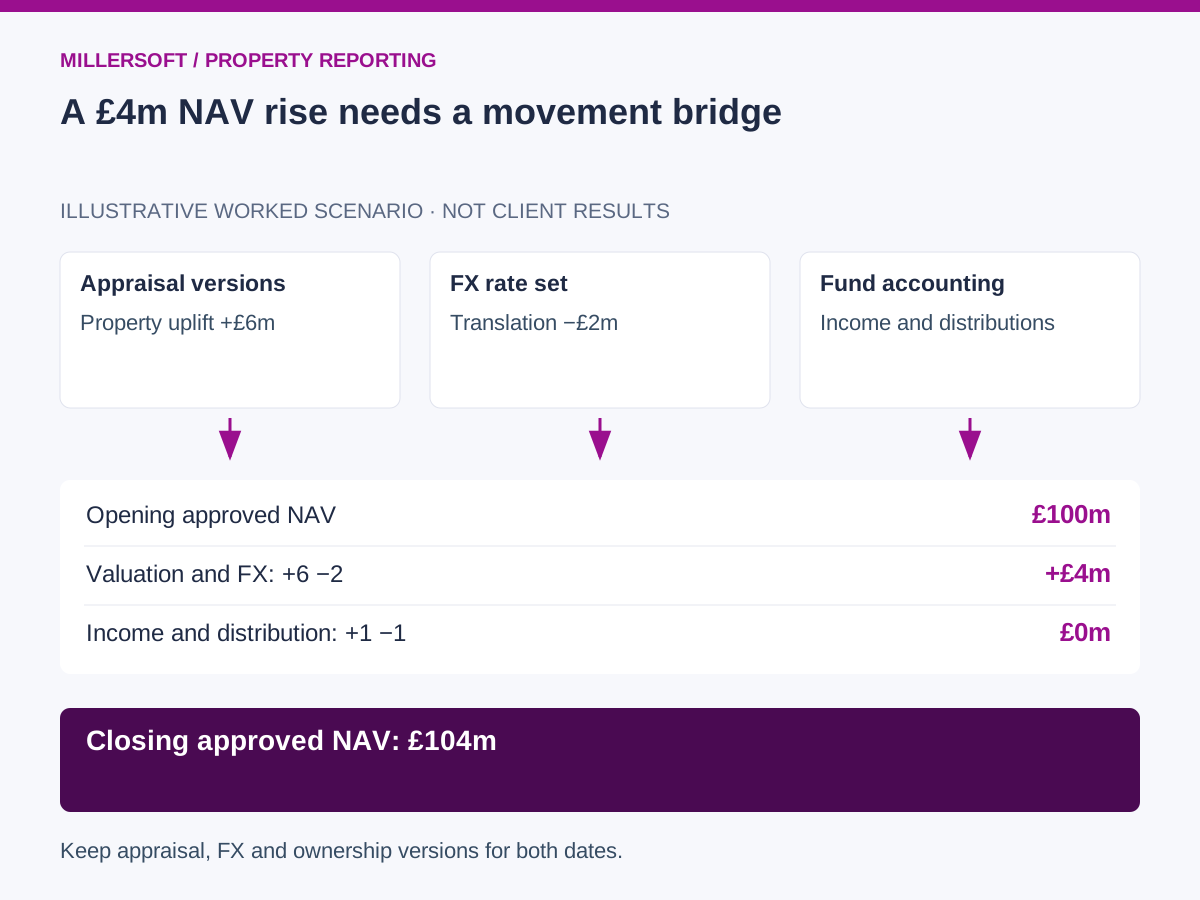
Consider an illustrative fund with an opening NAV of £100 million. Its approved closing NAV is £104 million. The team needs to explain the movement, rather than present only the two balances.
| Movement | NAV impact | Supporting dataset |
|---|---|---|
| Opening NAV | £100m | Previously approved snapshot |
| Property valuation uplift | +£6m | Approved appraisal versions |
| Currency translation effect | −£2m | Reporting-date FX rates |
| Net income after expenses | +£1m | Reconciled accounting records |
| Investor distribution | −£1m | Approved capital activity |
| Closing NAV | £104m | Current approved snapshot |
These simplified amounts assume no other movements. Property capital expenditure must be treated consistently with both the appraisal movement and cash balances so it is not counted twice. Debt, tax, non-controlling interests and ownership changes require additional lines when relevant.
 (opens the full-size image in a new tab)
What a valuation history model needs
Retain a stable property identifier and link each appraisal to its valuation basis, currency, valuer, effective date and approval record. Keep the original document reference so an analyst can check the supporting narrative as well as the amount.
Ownership needs its own effective-dated relationship. A 60% interest at quarter-end should not be applied retrospectively to a quarter when the fund owned 50%. Accounting treatment also depends on control and the applicable reporting policy, not only percentage ownership.
Store FX rate sets as named versions. Use the approved rate for the relevant measure and period, and record whether a movement is calculated in local currency or reporting currency. Avoid mixing rates from different workbooks in the same bridge.
How to introduce controlled NAV reporting
- Choose two consecutive approved reporting dates and one fund.
- Collect the appraisal, ledger, debt, cash, FX and capital activity inputs used for both dates.
- Reconcile opening and closing balances before attributing individual movements.
- Define movement categories and a documented calculation order to prevent overlapping effects.
- Have finance approve the bridge, then retain the full set of input and rule versions.
Measure the value of unexplained movements, the number of unapproved valuations used in drafts and the time needed to reproduce a previously issued figure. A useful output allows reviewers to move from a NAV line to the exact appraisal and ownership record behind it.
Frequently asked questions
Is NAV the same as the sum of property valuations?
No. NAV also reflects other assets and liabilities and the applicable accounting and fund policies. Appraisals are one input to the calculation.
Can we reproduce historical NAV if old valuation files were overwritten?
Only to the extent that evidence survives in backups, published packs or other approved records. A new warehouse can preserve future versions but cannot reconstruct missing history with certainty.
Continue exploring Yardi™ reporting
Back to the Yardi™ data warehouse overview.
- Yardi™ intercompany reconciliation and multi-entity reporting
- Yardi™ property ledger to fund accounts: reconciliation explained
Make your property reporting explainable
Talk to Millersoft about a focused Data Vault Engine & Studio pilot using your property data, reporting definitions and control requirements.
Discuss your reporting challengeYardi™ is a trademark of Yardi™ Systems, Inc. Millersoft is not affiliated with Yardi™ Systems, Inc.