Yardi™ property ledger to fund accounts: reconciliation explained

Property ledger to fund reconciliation connects the income, expenses and balances recorded for individual buildings to the figures reported by a fund or special purpose vehicle (SPV). For teams using Yardi™, the difficult part is often explaining differences between accounting bases, periods and entity structures across several systems.
A data warehouse can preserve those differences, apply agreed mappings and produce a reviewable reconciliation instead of another spreadsheet that only one person understands.
Why property balances do not always match fund accounts
A property manager may record operational activity in one chart of accounts while a fund administrator uses another. Journals may arrive after a reporting cut-off. Fund-level fees, financing costs and consolidation adjustments may never appear in the property ledger at all.
The first task is to agree what should reconcile. Property net operating income is not automatically the same measure as fund profit. Define the entities, period, currency and accounting basis before comparing totals. A difference can be legitimate and still need evidence.
Real-world example: a mixed-use development in Florida
IQ-EQ describes a New York investment manager whose Florida development combined housing, retail and public space. Its work included reviewing Yardi™ dimensions and stakeholder reports so development costs could be tracked consistently and reconciled to budgets. The published solution focused on configuring Yardi™ reporting, illustrating why the underlying reporting model matters. Read IQ-EQ's case study.
For a warehouse project, the practical lesson is to preserve those dimensions when bringing property and fund data together. Integration cannot repair an undefined reporting basis.
Worked scenario: explain a £50,000 quarter-end difference
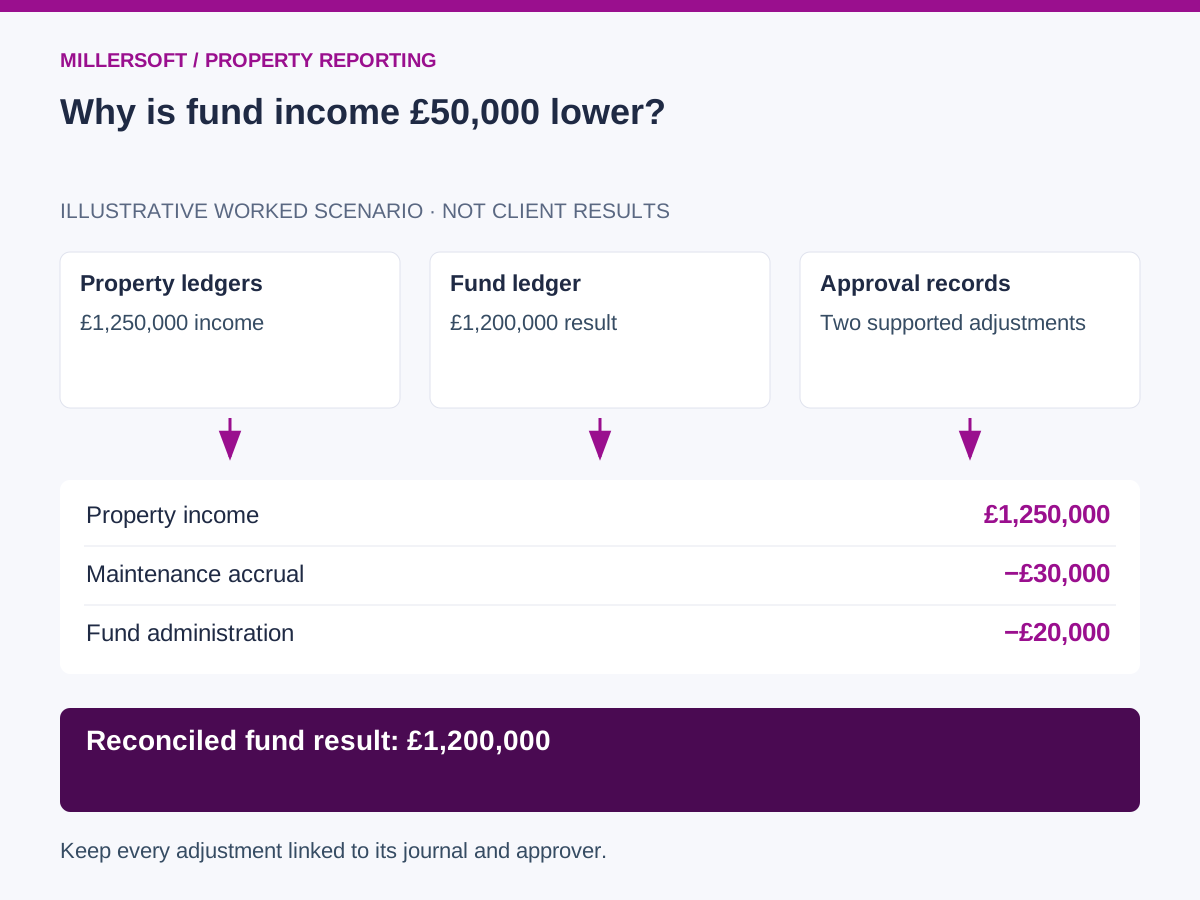
The following figures are illustrative, not results from the published case study. Three properties report combined quarterly operating income of £1,250,000. The fund reporting view shows £1,200,000 for the corresponding measure.
| Reconciliation step | Amount | Evidence required |
|---|---|---|
| Property ledger operating income | £1,250,000 | Period-end source extract |
| Accrual recorded only in the fund ledger | −£30,000 | Approved maintenance journal |
| Fund-level administration expense | −£20,000 | Expense allocation and invoice |
| Explained fund reporting result | £1,200,000 | Approved reconciliation bridge |
The warehouse matches the transactions it can identify and records the two approved adjustments separately. It does not insert a balancing journal simply to remove the difference. Any remaining amount stays visible as an exception with an owner and due date.
 (opens the full-size image in a new tab)
How to build a controlled reconciliation dataset
- Land both ledgers unchanged. Retain source transaction IDs, journal lines, accounting dates, extraction timestamps and debit or credit signs.
- Version account and entity mappings. Map property accounts to fund reporting categories, with effective dates and named approvers.
- Match at a useful level. Use document references and entity IDs before relying on amount-and-date matching. Flag ambiguous matches.
- Separate adjustments from source facts. Store the amount, rationale, reporting period, evidence and approval status of every adjustment.
- Freeze the approved output. Keep the extract versions and transformation rules used for the published quarter.
A Data Vault can retain source identities and historical mappings, while curated reporting views apply the approved reconciliation rules. Availability of source history and licensed extraction interfaces determines how far back the process can be reproduced.
What should the finance team measure?
Track unresolved differences by value and age, the percentage of transactions matched unambiguously, and the time needed to reproduce a signed-off balance. Compare those measures against a baseline before claiming an improvement.
Start with one fund and a small property set. A useful pilot ends with an approved reconciliation bridge and the ability to drill from a reporting line to the original journal, including exceptions that remain open.
Frequently asked questions
Can a warehouse replace the fund general ledger?
The ledger remains the accounting system of record. The warehouse supports comparison, history and reporting; approved journals still follow the organisation's posting process.
Should every property transaction have a fund-level match?
That depends on the reporting design. A fund ledger may contain summarised postings. In that case, reconcile controlled batches and totals while retaining transaction-level evidence underneath.
Continue exploring Yardi™ reporting
Back to the Yardi™ data warehouse overview.
- Yardi™ NAV reporting: preserve property valuation history
- Yardi™ ESG reporting: connect energy, emissions and property data
Make your property reporting explainable
Talk to Millersoft about a focused Data Vault Engine & Studio pilot using your property data, reporting definitions and control requirements.
Discuss your reporting challengeYardi™ is a trademark of Yardi™ Systems, Inc. Millersoft is not affiliated with Yardi™ Systems, Inc.