Yardi™ investor reporting and regulatory data preparation

Property fund investor reporting becomes expensive when each recipient needs a different workbook assembled from the same underlying data. A fund summary, lender covenant pack and regulatory dataset can share source records while using different definitions, scopes and approval requirements.
A warehouse alongside Yardi™ can provide reusable reporting datasets with explicit rules, so teams can explain both the figures and the differences between outputs.
Why copying a master spreadsheet is fragile
One investor asks for property-level operating income. Another wants a proportionate view of joint ventures. A lender specifies a covenant calculation with its own exclusions. Copying a spreadsheet for each request creates multiple versions of the business logic.
The resulting reports can disagree for legitimate reasons, but those reasons are difficult to distinguish from errors. A shared field called “income” is insufficient unless its accounting basis, period, entity perimeter and treatment of adjustments are defined.
Regulatory preparation adds another layer: the applicable obligation, template version and filing rules depend on the fund and jurisdiction. Reusable data helps, but the compliance team must determine the requirements for each submission.
Real-world example: statutory and proportionate reporting
British Land's 2025 results explain that IFRS presents joint ventures as single-line items, while management also reviews a proportionally consolidated view. Supplementary disclosures reconcile those presentations. This is a published example of maintaining two reporting bases with an explicit bridge. See page 17 of the results.
EPRA publishes Best Practices Recommendations and accompanying reporting tables to improve comparability in listed property reporting. Their existence illustrates that investor-facing metrics need a defined calculation basis, rather than a familiar label alone. Explore EPRA's reporting guidance and tables.
EPRA recommendations are not a universal regulatory template for private funds. The practical lesson is to manage each reporting definition and output version explicitly, including where a recipient requires a different basis.
Worked scenario: two income figures, one explainable bridge
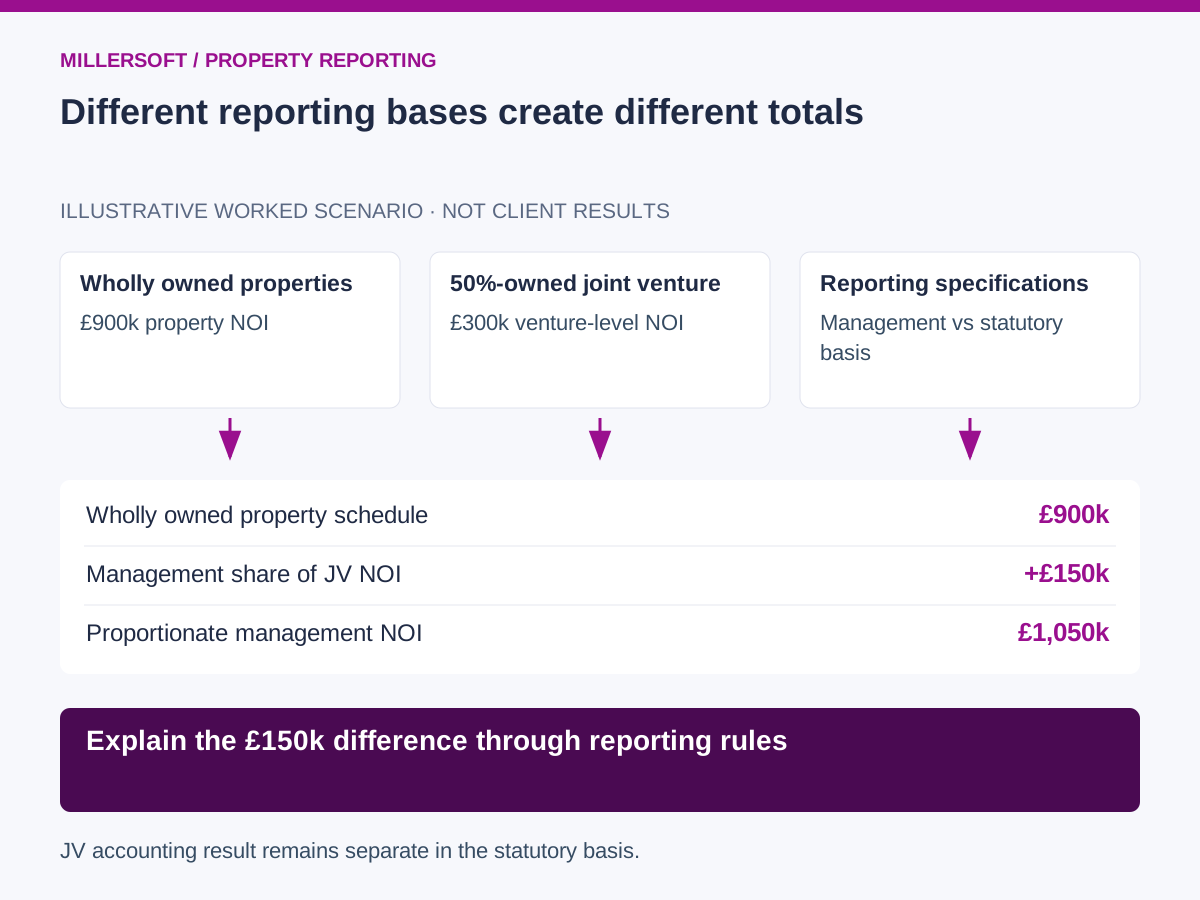
In an illustrative reporting quarter, a wholly owned property contributes £900,000 of net operating income and a 50%-owned joint venture contributes £300,000 at the venture level. Assume the approved statutory accounting treatment is the equity method for the joint venture.
| Output | Property income shown | Treatment of the joint venture |
|---|---|---|
| Management proportionate property schedule | £1,050,000 | £900,000 plus 50% of £300,000 |
| Statutory property revenue/expense presentation | £900,000 of wholly owned property NOI in the supporting schedule | JV result presented separately under the applicable accounting policy |
| Bridge between the property schedules | £150,000 | Proportionate JV NOI included only in management view |
The statutory statements do not simply report “£900,000 profit”: other income, costs and the share of the JV's accounting result still need their proper presentation. The example isolates the property NOI schedules to show why two outputs cannot be compared without their definitions.
 (opens the full-size image in a new tab)
Design reusable data with output-specific rules
Keep reconciled source records in a governed base layer. Build named measures above it, such as wholly owned property NOI and proportionate management NOI. Associate each measure with a definition, owner, effective date and approval record.
Maintain a reporting specification for every pack: recipient, period, entity perimeter, currency, rounding, template version, required validations and reviewer. Regulatory outputs should reference the applicable approved requirements rather than inherit assumptions from an investor workbook.
A publication snapshot should retain the dataset, calculation rules and rendered output. Saving only the final spreadsheet makes later questions harder to resolve when mappings or source records change.
A practical production workflow
- Agree one investor pack and its definitions before automating the layout.
- Reconcile its source balances and define accepted data-quality exceptions.
- Create reusable measures and document recipient-specific adjustments.
- Validate totals, mandatory fields, cross-report consistency and rounding.
- Obtain the required sign-off and retain the published version with supporting evidence.
A warehouse can feed familiar BI tools and controlled Excel or Sheetloom outputs. Success should be measured in reduced manual rekeying, fewer unexplained differences and faster responses to recipient queries, using an agreed baseline.
Frequently asked questions
Does a governed dataset guarantee a compliant filing?
No. Requirements, interpretations, eligibility and submission controls still need review by the responsible specialists. The dataset provides traceable inputs and repeatable calculations.
Can every recipient use the same metric definition?
Only when their requirements align. Preserve explicit variations and the bridge between them instead of giving different calculations the same unqualified label.
Continue exploring Yardi™ reporting
Back to the Yardi™ data warehouse overview.
- Yardi™ audit trails and restatements: reproduce reported figures
- Yardi™ cash flow forecasting and property fund liquidity
Make your property reporting explainable
Talk to Millersoft about a focused Data Vault Engine & Studio pilot using your property data, reporting definitions and control requirements.
Discuss your reporting challengeYardi™ is a trademark of Yardi™ Systems, Inc. Millersoft is not affiliated with Yardi™ Systems, Inc.