Yardi™ intercompany reconciliation and multi-entity reporting

Intercompany reconciliation becomes difficult when property SPVs, holding companies and funds record the same economic event differently. A loan appears as a receivable in one entity and a payable in another, but timing, currency or counterparty coding can prevent the balances from matching.
A warehouse connected to Yardi™ and other accounting systems can bring both sides into one review process while retaining the legal entity records required to explain them.
Why a consolidated total can hide an unresolved problem
Property structures often span multiple jurisdictions, currencies and accounting teams. Shared costs, management fees, shareholder loans and cash transfers create balances between entities. A consolidated report can appear plausible even when one side of a transaction is missing.
Entity hierarchy is also time-dependent. Acquisitions, disposals and restructuring change which entities belong in a reporting perimeter. Applying today's structure to last year's figures can distort comparisons.
The warehouse needs both a legal ownership view and a reporting view. They may differ because accounting consolidation depends on control, joint arrangements and the reporting policy, rather than a simple ownership roll-up.
Real-world example: Sweid & Sweid's reporting challenge
Yardi™'s published Sweid & Sweid case study describes manual consolidation and intercompany work across multiple systems and jurisdictions. The company adopted Yardi™'s platform and investment accounting tools to connect financial workflows. Read Yardi™'s account of the project.
This is a vendor-reported operational example, not a Millersoft implementation. It demonstrates the practical importance of connected entity and counterparty information. A warehouse can complement configured accounting workflows when analysis also needs external data or preserved historical structures.
Worked scenario: find the missing £20,000 loan balance
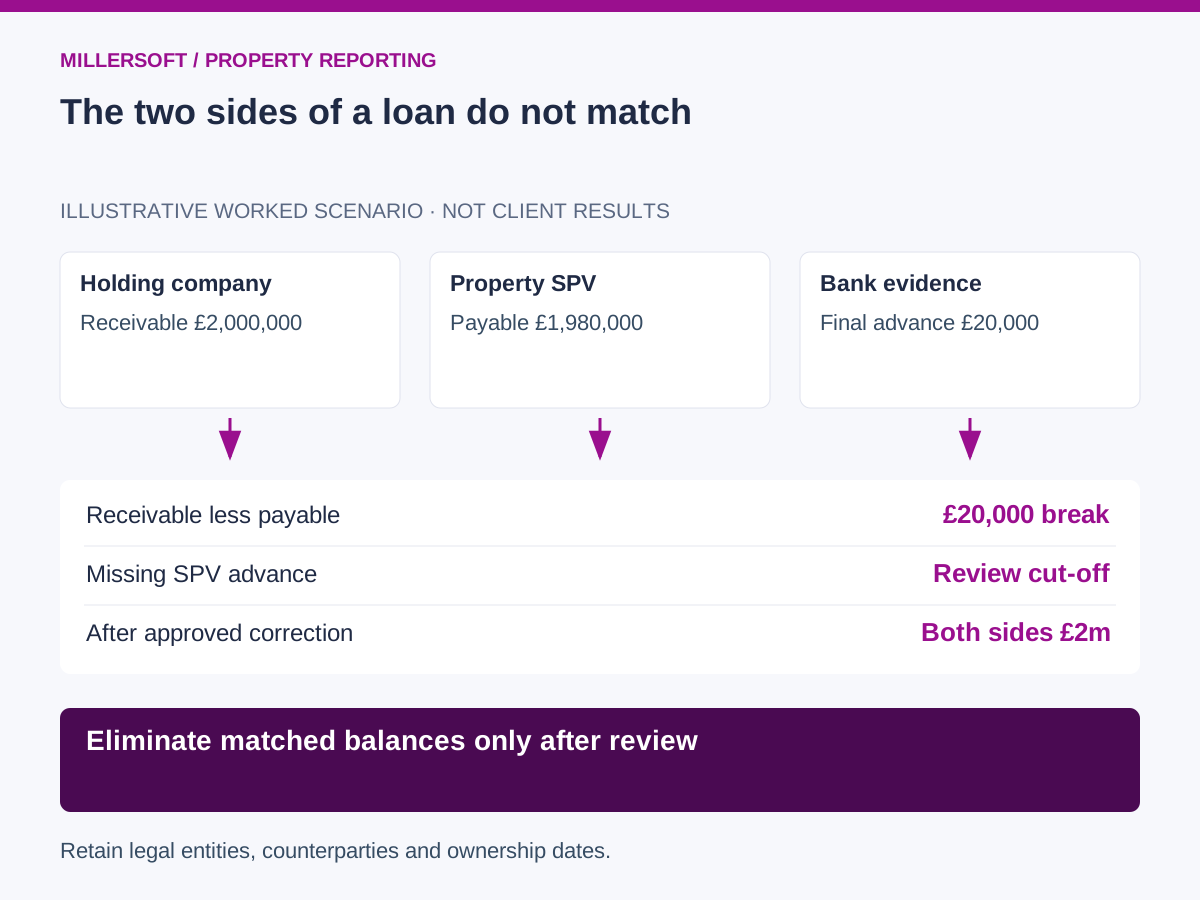
Assume a holding company records a £2 million loan receivable from a wholly owned property SPV. The SPV records a £1.98 million payable. Both balances have already been translated to the same reporting currency using the agreed basis.
| Record | Reported balance | Reconciliation finding |
|---|---|---|
| Holding company receivable | £2,000,000 | Includes a final £20,000 advance |
| Property SPV payable | £1,980,000 | Final advance not yet posted |
| Unmatched difference | £20,000 | Review bank evidence and posting cut-off |
These figures are illustrative. If the advance belongs in the period, the responsible team posts an approved correction in the accounting system. Once both sides equal £2 million, the consolidation process can eliminate the matched receivable and payable under the approved policy. The warehouse should never hide the £20,000 by silently forcing an elimination.
 (opens the full-size image in a new tab)
Model the relationships before automating eliminations
Use stable legal entity identifiers and an explicit intercompany counterparty field. Names alone are weak matching keys: abbreviations, renamed entities and local-language descriptions create false breaks.
Maintain effective-dated ownership links, consolidation method, reporting currency and inclusion rules. Store the original currency amounts as well as translated values. Separate principal, accrued interest and fees so a mismatch can be explained at a useful level.
An elimination record should identify both source balances, the rule used, the reporting perimeter and approval status. Keep unresolved exceptions outside the automatic elimination population until their treatment is agreed.
A practical month-end control sequence
- Validate that every included entity has submitted its balances.
- Check intercompany counterparties and reciprocal account mappings.
- Compare both sides by entity pair, currency, transaction type and period.
- Route missing postings, FX differences and disputed amounts to named owners.
- Apply approved eliminations and retain a before-and-after reporting bridge.
Start with a small ownership chain and one transaction class, such as shareholder loans. Measure unmatched balances, aged exceptions and the effort needed to explain changes in the consolidation perimeter.
Frequently asked questions
Can we consolidate simply by multiplying every balance by ownership percentage?
No. The applicable accounting treatment must be determined first. A reporting model should encode approved consolidation policies and distinguish statutory views from proportionate management analysis.
Must all entities use Yardi™?
No. A warehouse can integrate permitted extracts from multiple systems, provided account definitions, entity identifiers and reporting cut-offs are controlled.
Continue exploring Yardi™ reporting
Back to the Yardi™ data warehouse overview.
- Yardi™ rent roll analysis: lease exposure, WAULT and occupancy
- Yardi™ NAV reporting: preserve property valuation history
Make your property reporting explainable
Talk to Millersoft about a focused Data Vault Engine & Studio pilot using your property data, reporting definitions and control requirements.
Discuss your reporting challengeYardi™ is a trademark of Yardi™ Systems, Inc. Millersoft is not affiliated with Yardi™ Systems, Inc.