Yardi™ audit trails and restatements: reproduce reported figures

An audit trail for property fund reporting must explain what was reported, which records supported it and what changed afterwards. Rerunning a current Yardi™ extract is not enough when late journals, corrected source records or revised mappings have altered the historical period.
A warehouse with retained source versions and publication snapshots can support both the original reported view and the latest corrected view, with a documented bridge between them.
Why an old period changes when a report is rerun
A journal can be posted in May with an April accounting date. A supplier invoice can replace an estimate. An entity mapping can be corrected after a pack has been issued. All three changes can affect the rerun, even though the report still says “April”.
Distinguish the date a business event applies from the date the reporting platform first received it. Where available, retain the source modification timestamp as well. These dates answer different audit questions and should not be collapsed into a single field.
A changed number is not automatically a formal restatement. Finance determines the treatment under the applicable policy, including materiality, communication and approval requirements.
Real-world example: a published restatement policy
British Land's 2025 sustainability Reporting Criteria explain that prior-year data is restated when updated information produces a material change, with details given in the relevant sections. For example, its employee reporting methodology notes prior-year restatements to exclude non-executive directors previously included. The document also identifies selected data subject to limited assurance. Read the 2025 Reporting Criteria.
Although this example concerns sustainability disclosures, it demonstrates the reporting control problem directly: the published version and subsequent corrected information need a clear relationship. It does not imply a financial accounting error by British Land.
Worked scenario: a late £25,000 maintenance invoice
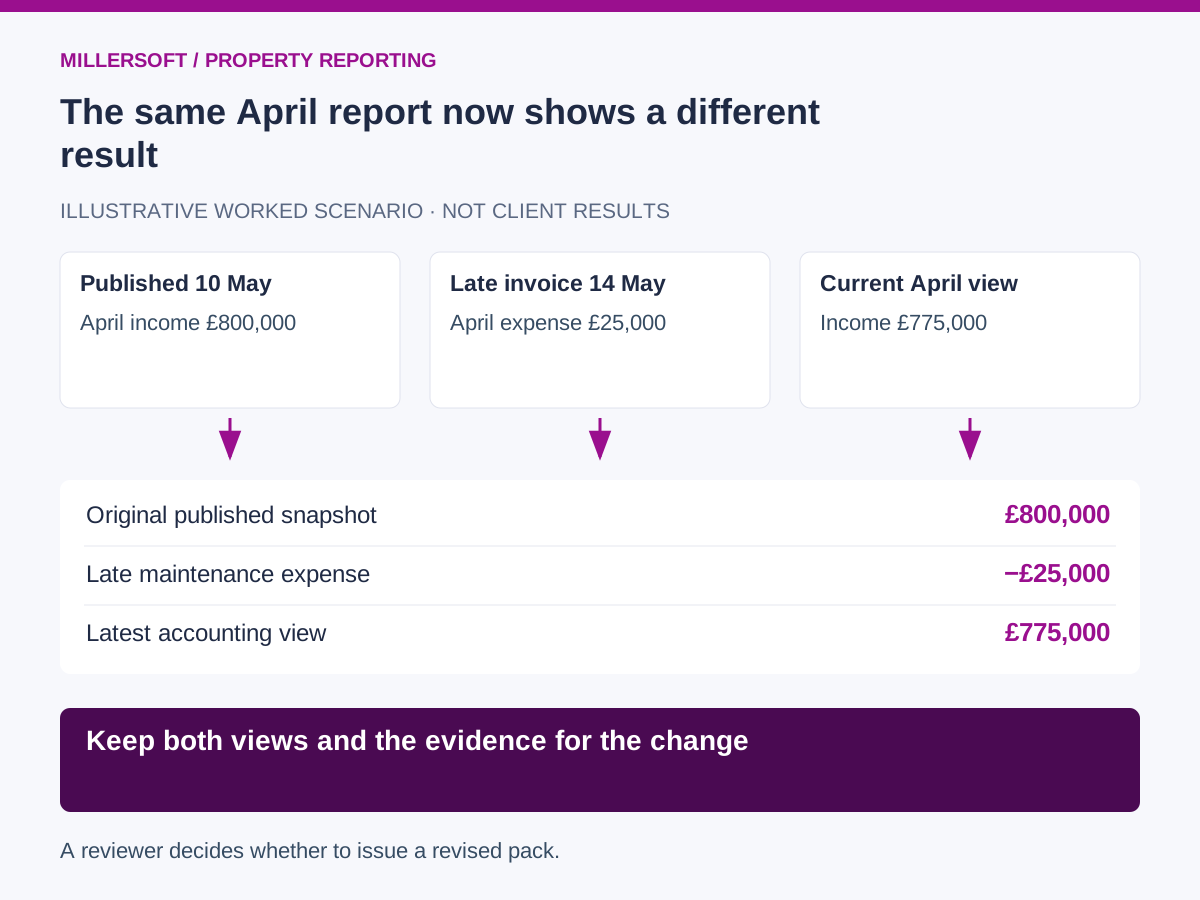
Assume an illustrative April investor pack was approved on 10 May with property operating income of £800,000. A £25,000 maintenance invoice is posted on 14 May with an April accounting date. No corresponding accrual was included in the approved pack.
| View | Property operating income | Meaning |
|---|---|---|
| April pack approved on 10 May | £800,000 | Figure originally published |
| Latest April accounting view | £775,000 | Includes the late expense |
| Change requiring review | −£25,000 | Linked to the new invoice and journal |
A publication snapshot preserves £800,000 and the inputs behind it. The latest reporting view shows £775,000. A change log links the difference to the invoice, posting date, accounting date and reviewer decision. Whether a revised pack is issued is an approval decision, not an automatic warehouse action.
 (opens the full-size image in a new tab)
What to retain for a defensible reporting trail
Store original source IDs, extract identifiers, load timestamps and source values. Capture updates and deletions where the available interface supports them. If an interface provides only current-state extracts, retain dated copies and document the limits of detecting changes between them.
Keep business mappings and calculation rules under version control or equivalent approval management. Reproducing an old source extract with today's mapping does not necessarily reproduce the old result.
For each publication, retain the report identifier, reporting period, source cut-off, input versions, rule versions, approval record and final output. Apply access controls and a documented retention policy appropriate to the underlying information.
Test a real audit question in the pilot
Choose one published figure and ask a reviewer to trace it to the source. Then introduce an approved late adjustment in a test dataset and demonstrate both the original view and the updated view.
The process should identify who approved the original figure, when the additional information arrived and why the later result differs. Measure time to retrieve evidence and the number of unexplained changes between publication versions.
A Data Vault can retain historical source facts and relationships, but publication control still requires an explicit process. Historical storage alone does not record that a particular version was approved and sent to investors.
Frequently asked questions
Is a database backup enough to reproduce an investor pack?
It may help recover records, but the report also depends on mappings, calculation logic, parameters and approvals. A publication snapshot should identify that complete set.
Should corrected data overwrite the original published figure?
Keep the original publication accessible and identify any revised issue separately. The current analytical view can reflect approved corrections while the publication history remains traceable.
Continue exploring Yardi™ reporting
Back to the Yardi™ data warehouse overview.
- Yardi™ ESG reporting: connect energy, emissions and property data
- Yardi™ investor reporting and regulatory data preparation
Make your property reporting explainable
Talk to Millersoft about a focused Data Vault Engine & Studio pilot using your property data, reporting definitions and control requirements.
Discuss your reporting challengeYardi™ is a trademark of Yardi™ Systems, Inc. Millersoft is not affiliated with Yardi™ Systems, Inc.