Yardi™ cash flow forecasting and property fund liquidity

Property fund liquidity reporting asks a practical question: can the right legal entity make its payments when they fall due? A combined cash balance alone cannot answer it. Some money may be restricted, held in a joint venture or required for near-term debt service.
A warehouse can combine Yardi™ rent and payment data with banking, financing schedules and approved capital expenditure plans to support a dated, entity-level cash flow forecast.
Why reported cash is different from available liquidity
Rent is billed before it is necessarily collected. Development invoices can fall due before an expected refinancing completes. Tenant deposits, lender-controlled reserves and cash trapped in another entity may be unavailable for a distribution.
Facilities need their own eligibility checks. Undrawn capacity is not automatically accessible: conditions, covenants, expiry dates and permitted uses matter. Cash and debt information should share a clear forecast cut-off so the same receipt is not included both in the opening balance and as a future inflow.
Real-world example: ring-fenced joint venture financing
British Land's financial policy, stated as at 31 March 2026, describes ring-fenced external financing in joint ventures and monitoring of projected borrowings, available facilities and debt maturities. Its approach demonstrates why liquidity analysis must consider financing structure as well as cash totals. Read British Land's financial policy.
The lesson for a property fund reporting model is to represent restrictions and entity boundaries explicitly. A portfolio-wide total should not imply that money can move freely between every account.
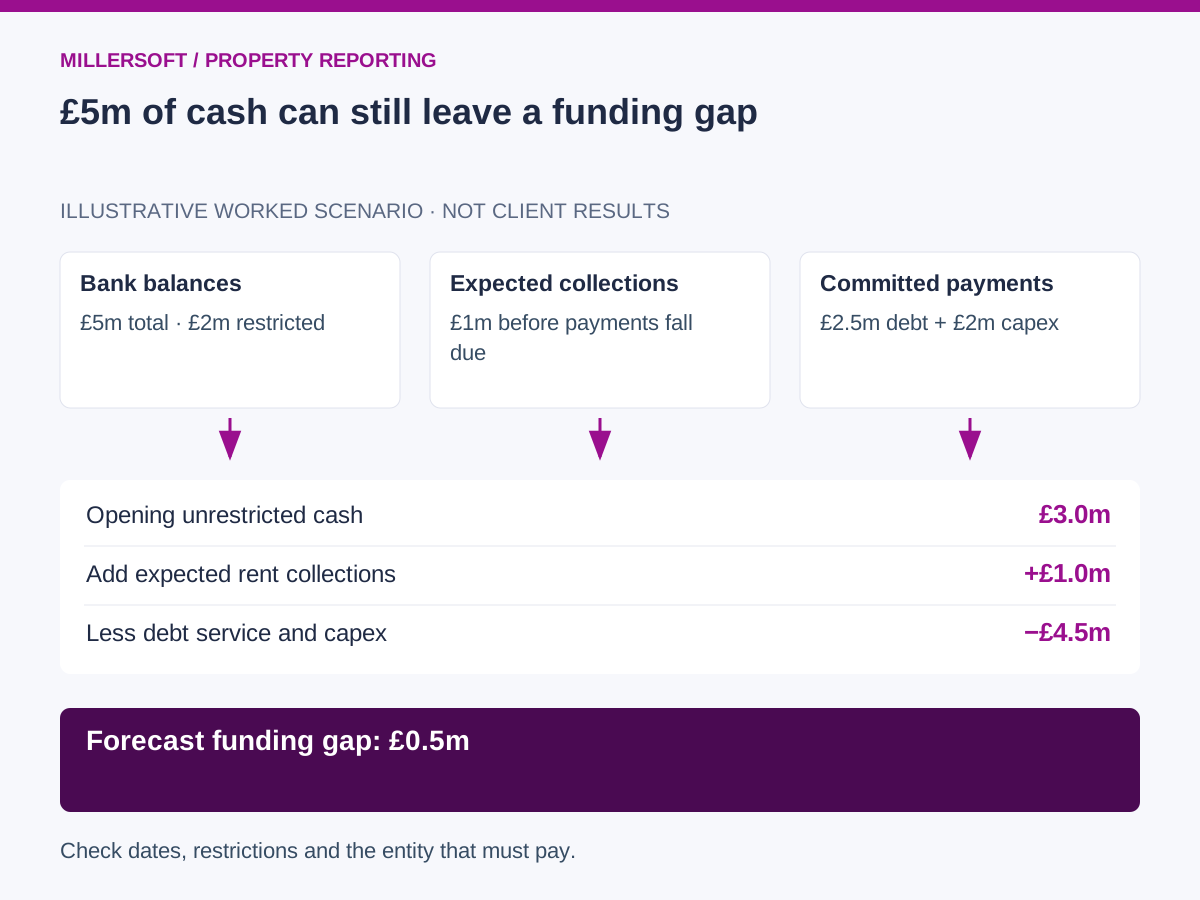
Worked scenario: £5 million in the bank, a £500,000 gap
Take an illustrative fund with £5 million in bank balances. Of that, £2 million is restricted and unavailable for the payments below. Before those payments fall due, the forecast includes £1 million of rent collections, £2.5 million of debt service and £2 million of committed capex.
| Liquidity bridge | Amount |
|---|---|
| Total opening bank balances | £5.0m |
| Restricted cash excluded | −£2.0m |
| Forecast rent collections before payment dates | +£1.0m |
| Debt service due | −£2.5m |
| Committed capex due | −£2.0m |
| Forecast unrestricted closing cash | −£0.5m |
The negative balance indicates a funding gap under these assumptions. It does not mean the bank account can actually become overdrawn. The team must identify an approved funding action, revise payment timing where contractually possible, or escalate the shortfall.
 (opens the full-size image in a new tab)
Build the forecast around dates and legal entities
Model bank accounts against their legal owners, currencies and restriction categories. Reconcile opening cash to bank evidence and the ledger. Keep pending transfers visible so an internal movement is not counted as new portfolio cash.
Bring together contractual debt payments, planned capex, approved capital calls, fees and tax payments. For rent, distinguish billed receivables from expected collections. Store the assumptions used for collection delays, vacancies and uncertain receipts as versioned forecast inputs.
Produce both entity-level and consolidated views. A solvent portfolio total can still contain an SPV that cannot pay tomorrow's invoice. Where intercompany funding is proposed, record the approvals and transfer dates needed to make that scenario feasible.
Use scenarios to expose timing risk
A 13-week forecast is a practical starting point for near-term cash management. Keep a base case and a downside case, with explicit changes such as delayed rent receipts or earlier capex payments. Preserve each forecast issue so actual outcomes can be compared against what treasury knew at the time.
Track the lowest projected unrestricted balance, upcoming debt maturities, available eligible facilities and forecast-versus-actual collection differences. Measure accuracy by time horizon rather than expecting a distant forecast to behave like next week's payment file.
Frequently asked questions
Should expected capital calls count as cash?
Show them as forecast inflows with their expected dates and approval status. They should remain distinguishable from cash already received.
Does a warehouse make funding decisions?
No. It supports treasury and finance with a consistent view of evidence and assumptions. Funding, distribution and covenant decisions remain subject to the organisation's approval processes.
Continue exploring Yardi™ reporting
Back to the Yardi™ data warehouse overview.
- Yardi™ investor reporting and regulatory data preparation
- Yardi™ rent roll analysis: lease exposure, WAULT and occupancy
Make your property reporting explainable
Talk to Millersoft about a focused Data Vault Engine & Studio pilot using your property data, reporting definitions and control requirements.
Discuss your reporting challengeYardi™ is a trademark of Yardi™ Systems, Inc. Millersoft is not affiliated with Yardi™ Systems, Inc.